>
Gobiiformes (Gobies) >
Gobiidae (Gobies) > Gobiinae
Etymology: Acentrogobius: Greek, a = without + Greek, kentron = sting + Latin gobius = gudgeon (Ref. 45335); violarisi: Named for Julius Violaris, owner of Nawe Constructions at Alotau (for allowing uninterrupted access to the survey site).
Eponymy: Julius Violaris is the owner of Nawe Constructions at Alotau, Papua New Guinea. [...] (Ref. 128868), visit book page.
Περιβάλλον: περιβάλλον / κλιματική ζώνη / εύρος βάθους / εύρος διανομής
Οικολογία
Θαλασσινό(ά) βενθικό(ς); εύρος βάθους 15 - 18 m (Ref. 100513). Tropical
Western Pacific: Papua New Guinea, but ptobably with a wider range across the East Indian region.
Μέγεθος / Βάρος / Ηλικία
Γεννητική Ωρίμανση: Lm ? range ? - ? cm
Max length : 3.0 cm SL (female)
Σύντομη περιγραφή
Κλείδες προσδιορισμού | Μορφολογία | Μορφομετρία
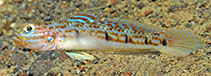
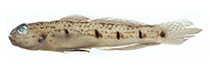
Ραχιαίες άκανθες (συνολικά) : 7; Μαλακές ραχιαίες ακτίνες (συνολικά) : 11; Εδρικές άκανθες: 1; Μαλακές εδρικές ακτίνες: 11. This species is distinguished by the following characters: D VI + I,11, the dorsal spines are thin and flexible, first longest with filamentous tip, 3.2 in SL, reaching to base of about fourth or fifth soft ray of second dorsal fin when laid back; A I,11; pectoral-fin rays 16-18; lanceolate caudal fin, longer than head length; 28-29 scales in longitudinal series; 8 transverse scales; 12-13 predorsal-scales; ctenoid scales cover the body, becoming cycloid on the breast, pectoral-fin base, and nape; cheek and opercle naked; when alive colour pale grey with brown scribbling on the back, with mid-lateral row of 4 short narrow black bars and spot (at caudal-fin base) positioned between pair of brown stripes extending from pectoral fin to caudal-fin base, pair of neon blue stripes across cheek, alternating blue and brown bands on dorsal fins, and orange spots on upper half of caudal fin (Ref. 100513).
Body shape (shape guide): elongated; Cross section: compressed.
The collection area consists of moderately sloped (about 20 degrees) mud substratum (the slope begins in approximately 1.5 m depth and flattens out at about 18 m). The featureless bottom has numerous burrows occupied by a variety of fishes and invertebrates, including this new species. Fewer than ten individuals were observed on the lower section of the slope (15-18 m ) and only widely scattered, solitary individuals were seen, each of which was invariably associated with a muddy burrow (Ref. 100513).
Κύκλος ζωής και συμπεριφορά ζευγαρώματος
Γεννητική Ωρίμανση | Αναπαραγωγή | Γεννοβολία | Αβγά | Γονιμότητα | Προνύμφες
Allen, G.R., 2015. Descriptions of two new gobies (Gobiidae: Acentrogobius) from Milne Bay Province, Papua New Guinea. J. Ocean Sci. Found. 14:1-13. (Ref. 100513)
Κατάσταση Κόκκινου Καταλόγου IUCN (Ref. 130435: Version 2025-2 (Global))
Απειλή για τον άνθρωπο
Harmless
Ανθρώπινες χρήσεις
αλιεία: με δυνητικό ενδιαφέρον
Εργαλεία
Ειδικές εκθέσεις
Λήψη XML
Διαδικτυακές πηγές
Εκτιμήσεις βάσει μοντέλων
Δείκτης φυλογενετικής ποικιλότητας (Αναφ.
82804): PD
50 = 0.5000 [Uniqueness, from 0.5 = low to 2.0 = high].
Bayesian length-weight: a=0.00794 (0.00340 - 0.01856), b=3.09 (2.91 - 3.27), in cm total length, based on LWR estimates for this Genus-body shape (Ref.
93245).
Τροφικό Επίπεδο (Αναφ.
69278): 3.1 ±0.4 se; based on size and trophs of closest relatives
Ελαστικότητα (Αναφ.
120179): Υψηλό, ελάχιστος χρόνος για διπλασιασμό πληθυσμού < 15 μήνες (Preliminary K or Fecundity.).
Ευπάθεια στην αλιεία (Ref.
59153): Low vulnerability (10 of 100).
🛈