Classificação / Nomes
Nomes comuns | Sinônimos | Catalog of Fishes(Gênero, Espécies) | ITIS | CoL | WoRMS | Cloffa
>
Cyprinodontiformes (Rivulines, killifishes and live bearers) >
Rivulidae (Rivulines) > Cynolebiinae
Etymology: Cynolebias: Greek, kyon = dog + Greek, odous = teeth + Greek, lebias = a kind of small fish (Ref. 45335).
Meio ambiente: milieu / Zona climática / intervalo de profundidade / faixa de distribuição
Ecologia
; Água doce bentopelágico. Tropical
South America: Verde Grande River drainage, Bahia, Brazil.
Tamanho / Peso / Idade
Maturidade: Lm ? range ? - ? cm
Max length : 3.8 cm SL macho/indeterminado; (Ref. 118117); 3.7 cm SL (female)
Descrição suscinta
Chaves de identificação | Morfologia | Morfometria
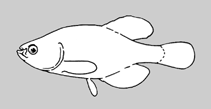
Cynolebias elegans is similar to other members of the C. gilbertoi group (C. gilbertoi and C. ochraceus) and distinguished from all other species of the subgenus Cynolebias, by having 19-16 vomerine teeth (vs. 1-4, when teeth are present), 7-8 gill-rakers on the ventral part of the first branchial arch (vs. 9-12), highest body depth at vertical just anterior to base of pelvic fin (vs. through base of pecto¬ral fin), and flank with light dots arranged in vertical groups (vs. light dots when present not arranged in vertical groups). It can be diagnosed from C. gil¬bertoi and C. ochraceus by possessing long dorsal and anal fins in males, their extremities excluding filaments posteri¬orly reaching base of caudal fin (vs. reaching caudal pedun¬cle), greater pre-pelvic length in males (52.2-53.9 % SL, vs. 48.5-49.9 % SL in C. gilbertoi and 48.9-50.5 % SL in C. ochraceus), and first proximal radial of the anal fin between neural spines of 9th and 10th vertebrae in males, and between neural spines of 11th and 12th vertebrae in females (vs. between neural spines of 11th and 13th verte¬brae in males, and between neural spines of 12th and 14th vertebrae in females). It can be further differentiated from C. gilbertoi by having the following characters: larger head (31.3-34.2 % SL in males, 32.1-33.4 % in females, vs. 27.9-30.3 % SL in males, 29.0-31.1 % in females) and smaller eye (25.5-29.1 % of head length in males, 27.3-29.9 % in fe¬males, vs. 30.0-31.0 % of head length in males, 31.5-34.2 % in females). It can be also distinguished from C. ochraceus by having 31-32 ver¬tebrae (vs. 33-34), narrower body depth (32.5-34.5 % SL vs. 35.0-37.8 % SL), and flank light pur¬plish brown in males (vs. light yellow ochre) (Ref. 118117).
Body shape (shape guide): fusiform / normal.
Ciclo de vida ou comportamento de acasalamento
Maturidade | Reprodução | Desova | Ovos | Fecundidade | Larvas
Costa, W.J.E.M., 2017. Description of two endangered new seasonal killifish species of the genus Cynolebias from the São Francisco River basin, Brazilian Caatinga (Cyprinodontiformes, Aplocheilidae). Zoosyst. Evol. 93(2):333-341. (Ref. 118117)
Status na Lista Vermelha da UICN (Ref. 130435: Version 2025-2 (Global))
Ameaça para os humanos
Harmless
Uso pelos humanos
Ferramentas
Relatórios especiais
Baixar XML
Fontes da internet
Estimativas baseadas em modelos
Índice de diversidade filogenética (Ref.
82804): PD
50 = 0.5000 [Uniqueness, from 0.5 = low to 2.0 = high].
Bayesian length-weight: a=0.01122 (0.00514 - 0.02450), b=3.04 (2.87 - 3.21), in cm total length, based on all LWR estimates for this body shape (Ref.
93245).
Nível Trófico (Ref.
69278): 3.2 ±0.4 se; based on size and trophs of closest relatives
Resiliência (Ref.
120179): Elevada, tempo mínimo de duplicação da população menor que 15 meses (Preliminary K or Fecundity.).
Vulnerabilidade da pesca (Ref.
59153): Low vulnerability (10 of 100).
🛈