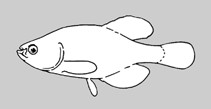
Klassifizierung / Names
Namen | Synonyme | Catalog of Fishes(Gattung, Arten) | ITIS | CoL | WoRMS | Cloffa
>
Cyprinodontiformes (Rivulines, killifishes and live bearers) >
Rivulidae (Rivulines) > Cynolebiinae
Etymology: Garcialebias: Named for Dr Graciela García and the Greek, 'lebias'; pongondo: The name pongondó is the local designation for the people living in the village of Povo Novo,
Rio Grande municipality, to where the new species is endemic.
Umwelt: Milieu / Klimazone / Tiefenbereich / Verbreitungsgebiet
Ökologie
; süßwasser benthopelagisch. Tropical
South America: São Gonçalo channel, Povo Novo, Rio Grande, Rio Grande do Sul state, Brazil.
Größe / Gewicht / Alter
Geschlechtsreife: Lm ? range ? - ? cm
Max length : 4.1 cm SL Männchen/unbestimmt; (Ref. 118117); 3.7 cm SL (female)
Lebenszyklus und Paarungsverhalten
Geschlechtsreife | Fortpflanzung | Ablaichen | Eier | Fruchtbarkeit | Larven
Costa, W.J.E.M., 2017. Description of two endangered new seasonal killifish species of the genus Cynolebias from the São Francisco River basin, Brazilian Caatinga (Cyprinodontiformes, Aplocheilidae). Zoosyst. Evol. 93(2):333-341. (Ref. 118117)
IUCN Rote Liste Status (Ref. 130435: Version 2025-2 (Global))
Bedrohung für Menschen
Harmless
Nutzung durch Menschen
Fischereien: nicht kommerziell
Tools
Zusatzinformationen
Download XML
Internet Quellen
Schätzungen auf der Grundlage von Modellen
Phylogenetischer Diversitätsindex (Ref.
82804): PD
50 = 0.5000 [Uniqueness, from 0.5 = low to 2.0 = high].
Bayesian length-weight: a=0.00617 (0.00266 - 0.01427), b=3.13 (2.93 - 3.33), in cm total length, based on LWR estimates for this (Sub)family-body shape (Ref.
93245).
Trophische Ebene (Ref.
69278): 3.2 ±0.4 se; based on size and trophs of closest relatives
Widerstandsfähigkeit (Ref.
120179): hoch, Verdopplung der Population dauert weniger als 15 Monate. (Preliminary K or Fecundity.).
Anfälligkeit der Fischerei (Ref.
59153): Low vulnerability (10 of 100).
🛈