>
Gobiiformes (Gobies) >
Gobiidae (Gobies) > Gobiinae
Etymology: Lubricogobius: Latin, lubricus = slipperiness, smoothness + Latin, gobius = gudgeon (Ref. 45335); tunicatus: Name referring to its commensal host, the tunicate; masculine singular adjective in the genitive case.
Environnement : milieu / zone climatique / profondeur / gamme de distribution
Écologie
marin benthopélagique; profondeur 20 - 30 m (Ref. 111062). Tropical
Western Pacific: Papua New Guinea.
Taille / Poids / Âge
Maturité: Lm ? range ? - ? cm
Max length : 1.1 cm SL mâle / non sexé; (Ref. 111062); 1.2 cm SL (female)
Description synthétique
Clés d'identification | Morphologie | Morphométrie
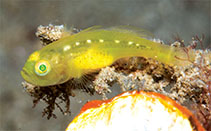
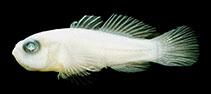
Épines dorsales (Total) : 7; Rayons mous dorsaux (Total) : 9 - 10; Épines anales: 1; Rayons mous anaux: 6 - 7; Vertèbres: 24. This species is distinguished by the following characters: D VI-I,9-10 (rarely 10); A I,6-7; pectoral-fin rays 17-19 (rarely 17 or 19); both the anterior and posterior nostrils are present; no scales; pelvic disc with conspicuous frenum; greatest body depth 3.1-3.7 in SL; head length 2.7-3.2 in SL; head compressed, its width 1.0-1.3 in head depth; caudal fin is rounded, 2.6-3.5 in SL. Colouration: in life either semi-translucent dull yellowish or semi-translucent whitish, both varieties with pigment along vertebral column, as alternating long, dark, dash-like marks with intervening shorter white sections; head and body are covered in a uniform scattering of fine melanophores (Ref. 111062).
Cross section: oval.
Apparently invariably associated with a (Polycarpa sp.) on silty-sand bottoms. which was common between about 13-30 m, but only populated by fishes below a depth of about 20 m. About a third of the tunicates below 20 m were estimated to be occupied by fish, solitary or in pairs. The fish were usually observed perched on the lip of the tunicate’s oral or incurrent siphon, retreating quickly inside when disturbed and also made brief forays on the exterior part of the tunicate and around its base (Ref. 111062).
Cycle de vie et comportement reproducteur
Maturité | Reproduction | Frai | Œufs | Fécondité | Larves
Allen, G.R. and M.V. Erdmann, 2016. Lubricogobius tunicatus, a new species of goby (Pisces: Gobiidae) from Papua New Guinea and the first record of L. ornatus from the East Indies. J. Ocean Sci. Found. 24:24-34. (Ref. 111062)
Statut dans la liste rouge de l'IUCN (Ref. 130435: Version 2025-2 (Global))
Menace pour l'homme
Harmless
Utilisations par l'homme
Pêcheries: sans intérêt
Outils
Articles particuliers
Télécharger en XML
Sources Internet
Estimations basées sur des modèles
Indice de diversité phylogénétique (Réf.
82804): PD
50 = 0.5078 [Uniqueness, from 0.5 = low to 2.0 = high].
Bayesian length-weight: a=0.01023 (0.00477 - 0.02194), b=3.01 (2.83 - 3.19), in cm total length, based on LWR estimates for this (Sub)family-body shape (Ref.
93245).
Niveau trophique (Réf.
69278): 2.9 ±0.3 se; based on size and trophs of closest relatives
Résilience (Réf.
120179): Haut, temps minimum de doublement de population inférieur à 15 mois (Preliminary K or Fecundity.).
Vulnérabilité de la pêche (Ref.
59153): Low vulnerability (10 of 100).
🛈