>
Syngnathiformes (Pipefishes and seahorses) >
Syngnathidae (Pipefishes and seahorses) > Syngnathinae
Etymology: Hippocampus: Greek, ippos = horse + Greek,kampe = curvature (Ref. 45335); japapigu: Name from the colloquial Japanese name, Japapigu or Japan pig or 日本のピグミータツノオトシゴ.
Milieu: milieu / Klimaatzone / Diepte / verspreidingsgebied
Ecologie
marien rifbewoner; standvastig; diepte 5 - 22 m (Ref. 118476), usually 10 - 13 m (Ref. 118476). Subtropical
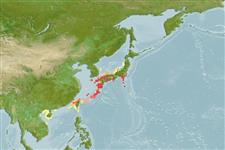
Northwestern Pacific: Japan and Chinese Taipei.
Grootte / Gewicht / Leeftijd
Maturiteit: Lm ? range ? - ? cm
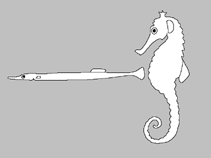
Max length : 1.6 cm SL mannelijk / geslacht onbekend; (Ref. 118476)
Korte beschrijving
Determinatiesleutels | Morfologie | Morfometrie
Dorsale zachte stralen (totaal) : 14. This species is distinguished from its congeners by the following set of characters: 28 tail rings; 14 dorsal fin rays; 9 pectoral fin rays; 4 subdorsal rings; bilaterally paired wing-like protrusions are formed by a pair of large truncate spines projecting laterad on first superior trunk ridge; elevated dorsal ridge is formed by unique triangular bony mounds dorsally on second, the third and fourth trunk rings with the posterior mound less pronounced; a large and prominent spine projecting laterad on eighth lateral trunk ridge (Ref. 118476).
Body shape (shape guide): other (see remarks); Cross section: angular.
This species was not associated with a particular host. It has been observed in association with mixed soft coral, Halimeda sp. (coralline algae) and hydroids on rocky reef walls and large boulders in both exposed and semi-sheltered locations (Ref. 118476)..
Levenscyclus en paargedrag
Maturiteit | Voortplanting | Paaien | Eieren | Fecunditeit | Larven
Short, G., R. Smith, H. Motomura, D. Harasti and H. Hamilton, 2018. Hippocampus japapigu, a new species of pygmy seahorse from Japan, with a redescription of H. pontohi (Teleostei, Syngnathidae). ZooKeys 779:27-49. (Ref. 118476)
Status op de Rode Lijst van het IUCN (Ref. 130435: Version 2025-2 (Global))
Gevaar voor de mens
Harmless
Gebruik door de mens
Tools
Speciale rapporten
Download XML
Internetbronnen
Schattingen op basis van modellen
Fylogenetische diversiteitsindex (Ref.
82804): PD
50 = 0.5000 [Uniqueness, from 0.5 = low to 2.0 = high].
Bayesian length-weight: a=0.00447 (0.00176 - 0.01132), b=3.00 (2.78 - 3.22), in cm total length, based on LWR estimates for this (Sub)family-body shape (Ref.
93245).
Trofisch niveau (Ref.
69278): 3.0 ±0.3 se; based on size and trophs of closest relatives
Weerstandsvermogen (Ref.
120179): Hoog, minimale populatieverdubbelingstijd minder dan 15 maanden (Preliminary K or Fecundity.).
Kwetsbaarheid van de visserij (Ref.
59153): Low vulnerability (10 of 100).
🛈