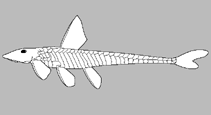
Classificação / Nomes
Nomes comuns | Sinónimos | Catalog of Fishes(Género, Espécies) | ITIS | CoL | WoRMS | Cloffa
>
Siluriformes (Catfishes) >
Loricariidae (Armored catfishes) > Hypostominae
Etymology: raso: The specific name raso,/i> is used in reference to the type locality, the igarapé Balneário Raso, a tributary of the rio Amapá, Atlantic coastal drainage. A noun in apposition.
Ambiente: milieu / zona climática / intervalo de profundidade / gama de distribuição
Ecologia
; Água doce demersal. Tropical
South America: Rio Raso, rio Amapá basin in Brazil.
Tamanho / Peso / Idade
Maturidade: Lm ? range ? - ? cm
Max length : 4.6 cm SL macho/indeterminado; (Ref. 118148)
Descrição breve
Chaves de identificação | Morfologia | Morfometria
Espinhos dorsais (total) : 2; Raios dorsais moles (total) : 7; Espinhos anais: 1; Raios anais moles: 5. Lithoxus raso is distinguished from all its congeners, with the exception of L. pallidimaculatus, by having large light spots all over the body, spots similar in size with orbit diameter, (vs. light spots over the body absent or light spots very small, similar to size of a tooth, covering only the dorsal portion of the head in L. boujardi); from L. surinamensis and L. pallidimaculatus by possessing an adipose fin (vs. adipose fin absent); from L. lithoides and L. jantjae by having five branched rays in the anal fin (vs. four); and from L. jantjae by having 14 branched rays in the caudal fin (vs. 12). In addition, Lithoxus raso is distinct from L. bovallii by having a lower premaxillary tooth cup length, 3.3-4.0% HL (vs. 4.2-10.4% HL); from L. boujardi by having a greater adipose-spine length, 7.2-8.1% SL (vs. 3.6-4.7% SL), and a greater dorsal adipose-caudal distance, 13.1-14.6% SL (vs. 10.3-11.7% SL); from L. planquettei by smaller caudal peduncle depth, 8.4- 8.6% SL (vs. 9.7-10.5% SL); and from L. stocki by having an enlarged and widened cusp of medial premaxillary teeth (vs. cusps of all premaxillary teeth similar in size, not enlarged), and by having a shorter cleithral width, 30.9-31.2% SL (vs. 32.6-34.2% SL) (Ref. 118148).
Body shape (shape guide): elongated.
Facultative air-breathing in the genus (Ref. 126274); Inhabits small- to medium-sized rivers with rocks and sand on the bottom (Ref. 118148).
Ciclo de vida e comportamento de acasalamento
Maturidade | Reprodução | Desova | Ovos | Fecundidade | Larvas
Silva, G.S.C., R. Covain, C. Oliveira and F.F. Roxo, 2017. Description of two new species of Lithoxus (Hypostominae: Loricariidae) from rio Jari and rio Amapá basins, Brazillian Guiana shield. Zootaxa 4347(1):151-168. (Ref. 118148)
Categoria na Lista Vermelha da IUCN (Ref. 130435: Version 2025-2 (Global))
Ameaça para o homem
Harmless
Utilização humana
Ferramentas
Relatórios especiais
Descarregue XML
Fontes da internet
Estimativas baseadas em modelos
Índice de diversidade filogenética (Ref.
82804): PD
50 = 0.5039 [Uniqueness, from 0.5 = low to 2.0 = high].
Bayesian length-weight: a=0.01549 (0.00726 - 0.03306), b=2.96 (2.79 - 3.13), in cm total length, based on LWR estimates for this (Sub)family-body shape (Ref.
93245).
Resiliência (Ref.
120179): Elevada, tempo mínimo de duplicação da população menor que 15 meses (Preliminary K or Fecundity.).
Vulnerabilidade da pesca (Ref.
59153): Low vulnerability (10 of 100).
🛈