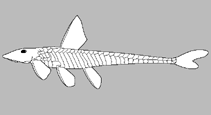
Ταξινόμηση / Ονόματα
Κοινά ονόματα | Συνώνυμα | Catalog of Fishes(Γένος, Είδη) | ITIS | CoL | WoRMS | Cloffa
>
Siluriformes (Catfishes) >
Loricariidae (Armored catfishes) > Hypoptopomatinae
Etymology: Curculionichthys: Derived from the from the Latin 'curculionem' (elongated snout) and from the Greek 'ichthys' (fishes), in reference to the relatively elongated snouts of the fish species included in this genus; tukana: The specific name, tukana, is derived from the Tupi-Guarani language, and it is related to the name of the rio Tocantins, where this new species occurs. Tocantins came from Tupi-Guarani language and means 'Tucano beak' with the junction of the two words tukana (Tucano) and tim (beak). A noun in apposition.
Περιβάλλον: περιβάλλον / κλιματική ζώνη / εύρος βάθους / εύρος διανομής
Οικολογία
; Γλυκού νερού βενθικό(ς). Tropical
South America: Rio Tocantins basin, Brazil.
Μέγεθος / Βάρος / Ηλικία
Γεννητική Ωρίμανση: Lm ? range ? - ? cm
Max length : 2.4 cm SL αρσενικό/απροσδιόριστο; (Ref. 118146)
Σύντομη περιγραφή
Κλείδες προσδιορισμού | Μορφολογία | Μορφομετρία
Μαλακές ραχιαίες ακτίνες (συνολικά) : 9; Μαλακές εδρικές ακτίνες: 6. Curculionichthys tukana is distinguished from its all congeners, with the exception of C. karipuna and C. oliveirai, by having one abdominal median plate series (vs. three or more abdominal medial plates series); from C. karipuna by the lack of an irregular concentration of chromatophores that entirely cover the anal-fin origin and adjacent region, and distal portion of the first unbranched anal-fin ray (vs. such pigmentation pattern present); from C. oliveirai, and also from C. insperatus, C. paresi and C. sagarana, by having seven to eight plates in abdominal lateral plates series (vs. four to six plates in abdominal lateral plates series); from C. itaim, C. luteofrenatus and C. piracanjuba by having papillae aligned in series that extends from the distal portion of lower lip to dentary (vs. all papillae randomly distributed throughout lower lip). Furthermore, Curculionichthys tukana can be separated from C. insperatus and C. oliveirai by lacking large conspicuous odontodes forming rows on head and trunk (vs. large, conspicuous odontodes forming rows on the head present); from C. oliveirai and C. coxipone by having the anterior profile of the head pointed (vs. anterior profile of head rounded); from C. paresi by having 12-18 premaxillary teeth (vs. 6-10) and 10-16 dentary teeth (vs. 4-7); from C. sabaji by the absence of dark-brown spots scattered over the body (vs. the presence of dark-brown spots); from C. paresi by absence of contrasting dark spots at the anterodorsal region of body (vs. the presence of such pigmentation pattern). In addition, Curculionichthys tukana can be differentiated from C. piracanjuba by having odontodes forming aligned rows, more evident in the dorsal portion of head and in the lateral portion of caudal peduncle (vs. odontodes not forming rows on the supraoccipital, on the compound pterotic, and on the lateral plates series) (Ref. 118146).
Body shape (shape guide): elongated.
Κύκλος ζωής και συμπεριφορά ζευγαρώματος
Γεννητική Ωρίμανση | Αναπαραγωγή | Γεννοβολία | Αβγά | Γονιμότητα | Προνύμφες
Roxo, F.F., A.C. Dias, G.S.C. Silva and C. Oliveira, 2017. Two new species of Curculionichthys (Siluriformes: Loricariidae) from the rio Amazonas basin, Brazil. Zootaxa 4341(2):258-270. (Ref. 118146)
Κατάσταση Κόκκινου Καταλόγου IUCN (Ref. 130435: Version 2025-2 (Global))
Απειλή για τον άνθρωπο
Harmless
Ανθρώπινες χρήσεις
αλιεία: χωρίς ενδιαφέρον
Εργαλεία
Ειδικές εκθέσεις
Λήψη XML
Διαδικτυακές πηγές
Εκτιμήσεις βάσει μοντέλων
Δείκτης φυλογενετικής ποικιλότητας (Αναφ.
82804): PD
50 = 0.5001 [Uniqueness, from 0.5 = low to 2.0 = high].
Bayesian length-weight: a=0.00977 (0.00434 - 0.02202), b=3.06 (2.87 - 3.25), in cm total length, based on LWR estimates for this (Sub)family-body shape (Ref.
93245).
Τροφικό Επίπεδο (Αναφ.
69278): 2.7 ±0.1 se; based on size and trophs of closest relatives
Ελαστικότητα (Αναφ.
120179): Υψηλό, ελάχιστος χρόνος για διπλασιασμό πληθυσμού < 15 μήνες (Preliminary K or Fecundity.).
Ευπάθεια στην αλιεία (Ref.
59153): Low vulnerability (10 of 100).
🛈