Classificatie / Namen
Lokale namen | Synoniemen | Catalog of Fishes(Genus, Soort(en)) | ITIS | CoL | WoRMS | Cloffa
>
Siluriformes (Catfishes) >
Loricariidae (Armored catfishes) > Hypoptopomatinae
Etymology: ephippia: The specific epithet ephippia (L. ephippium, Gr. ephippion means saddle) refers to the saddlelike
mid-dorsal blotches.
Milieu: milieu / Klimaatzone / Diepte / verspreidingsgebied
Ecologie
; zoet water demersaal. Tropical
South America: Essequibo and Branco basins in Guyana.
Grootte / Gewicht / Leeftijd
Maturiteit: Lm ? range ? - ? cm
Max length : 4.5 cm SL mannelijk / geslacht onbekend; (Ref. 110244)
Korte beschrijving
Determinatiesleutels | Morfologie | Morfometrie
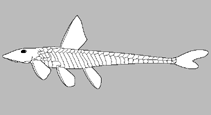
Dorsale zachte stralen (totaal) : 7; Anale zachte stralen: 6. Oxyropsis ephippia can be diagnosed from other congeners by the possessing a keel-like row of odontodes above the lateral-line canal on each median plate that is dominated by a single odontode (one closest to posterior margin of plate) conspicuously enlarged, typically one-third to one-half larger (along base-tip axis) than preceding one in same row (vs.keel-like row immediately above lateral-line with odontodes of roughly equal size). It further differs by having the sides of the trunk below the median series, approximately between plates 7 to 12, shielded by plates of the midventral series, with the exclusion of plates from the ventral series, which are visible only in ventral view of the trunk (vs. sides of the trunk shielded by plates of the midventral series and ventral series, the latter visible in lateral and ventral views of the trunk). It is also distinct from other congeners by its trunk median series with 23 plates (vs. 18-19 in O. acutirostra and 25-26 in O. carinata and O. wrightiana) and caudal peduncle in cross section slightly compressed at the level of the median plates 20-23 (vs. posterior caudal peduncle depressed); from O. acutirostra by having median series of plates complete (vs. series incomplete); from both O. acutirostra and O. wrightiana by having a deeper caudal peduncle (mean depth 4.8% SL vs. 2.9% and 2.0%, respectively), and shorter caudal peduncle (mean length 36.0% SL vs. 42.4% and 44.4%, respectively); and from O. carinata by possessing a larger eye (mean orbital diameter 18.2% HL vs. 15.7% HL) (Ref. 110244).
Body shape (shape guide): elongated.
Found in small to medium-sized streams with moderate current and riparian forest, water ranges from moderately turbid (e.g., Essequibo mainstem), to clear (Yuora), to black (Burro Burro). Most of the collecting localities are composed of a variety of substrates with sand being particularly common (Ref. 110244).
Levenscyclus en paargedrag
Maturiteit | Voortplanting | Paaien | Eieren | Fecunditeit | Larven
Aquino, A.E. and M.H. Sabaj Pérez, 2016. Oxyropsis ephippia, a new Hypoptopomatine catfish (Siluriformes: Loricariidae) from Guyana. Zootaxa 4136(1):129-140. (Ref. 110244)
Status op de Rode Lijst van het IUCN (Ref. 130435: Version 2025-2 (Global))
Gevaar voor de mens
Harmless
Gebruik door de mens
Tools
Speciale rapporten
Download XML
Internetbronnen
Schattingen op basis van modellen
Fylogenetische diversiteitsindex (Ref.
82804): PD
50 = 0.7500 [Uniqueness, from 0.5 = low to 2.0 = high].
Bayesian length-weight: a=0.00977 (0.00434 - 0.02202), b=3.06 (2.87 - 3.25), in cm total length, based on LWR estimates for this (Sub)family-body shape (Ref.
93245).
Weerstandsvermogen (Ref.
120179): Hoog, minimale populatieverdubbelingstijd minder dan 15 maanden (Preliminary K or Fecundity.).
Kwetsbaarheid van de visserij (Ref.
59153): Low vulnerability (10 of 100).
🛈