>
Cichliformes (Cichlids, convict blennies) >
Cichlidae (Cichlids) > Pseudocrenilabrinae
Etymology: Astatoreochromis: Greek, astato = unstable + Greek, rheos = stream + Greek, chromis = a marine fish without identification, dealing with perch; cited by Plinius (Ref. 45335); straeleni: Named in honour of Prof. V. Van Straelen, Director of the Musée du Congo Belge, Tervuren, Belgium from 1926 to 1954 (Ref. 126033).
Eponymy: Professor Victor Émile van Straelen (1889–1964) was a Belgian geologist, palaeontologist, carcinologist and naturalist. [...] (Ref. 128868), visit book page.
More on author: Poll.
Entorno: milieu / zona climática / rango de profundidad / gama de distribución
Ecología
; agua dulce bentopelágico. Tropical; 24°C - 28°C (Ref. 2059); 3°S - 8°S
Africa: Rusizi, Lukuga and Malagarazi basins and Luiche River, a small affluent of Lake Tanganyika (Ref. 5602, 126033); apparently also enters Lake Tanganyika (Ref. 126033).
Tamaño / Peso / Edad
Madurez: Lm ? range ? - ? cm
Max length : 13.0 cm SL macho / no sexado; (Ref. 4967)
Descripción breve
Claves de identificación | Morfología | Morfometría
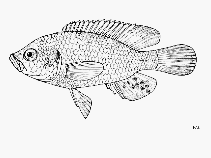
Espinas dorsales (total) : 16 - 19; Radios blandos dorsales (total) : 8 - 10; Espinas anales: 3 - 4; Radios blandos anales: 8 - 10. Diagnosis: Astatoreochromis straeleni can be distinguished from A. alluaudi by the possession of 3-4 anal spines vs. 4-7; 16-18, exceptionally 19, dorsal spines vs. 17-19 dorsal spines, rarely 16 or 20 (Ref. 126033).
Body shape (shape guide): fusiform / normal; Cross section: oval.
Aastatoreochromis straeleni is primarily a riverine species, prefering clear water and caught in swampy flooded areas and marginal vegetation with a high water transparency (Ref. 126033). In Lake Tanganyika, it is found only at the mouths of rivers and in their associated swamps (Ref. 6770). Omnivorous, swamp-dweller (Ref. 6770), reported to feed mainly on snails, ostracods and insects (Ref. 126033). This species is a mouth-brooder (Ref. 126033).
Ciclo vital y comportamiento de apareamiento
Madurez | Reproducción | Puesta | Huevos | Fecundidad | Larva
This species is a mouth-brooder (Ref. 126033). Nothing has been reported about its breeding period, but most probably it reproduces at the start of the short dry season from December to January (Ref. 126033).
van Oijen, M.J.P. and J. Snoeks, 1991. Astatoreochromis. p. 9-10. In J. Daget, J.-P. Gosse, G.G. Teugels and D.F.E. Thys van den Audenaerde (eds.) Checklist of the freshwater fishes of Africa (CLOFFA). ISNB, Brussels; MRAC, Tervuren; and ORSTOM, Paris. Vol. 4. (Ref. 5602)
Situación en la Lista Roja de la UICN (Ref. 130435: Version 2025-2 (Global))
Amenaza para el ser humano
Harmless
Usos humanos
Pesquerías: sin interés; Acuario: Comercial
Herramientas
Informes especiales
Descargar XML
Fuentes de Internet
Estimaciones basadas en modelos
Índice de diversidad filogenética (Referencia
82804): PD
50 = 0.7500 [Uniqueness, from 0.5 = low to 2.0 = high].
Bayesian length-weight: a=0.01445 (0.00671 - 0.03113), b=2.99 (2.82 - 3.16), in cm total length, based on LWR estimates for this (Sub)family-body shape (Ref.
93245).
Nivel trófico (Referencia
69278): 3.4 ±0.4 se; based on size and trophs of closest relatives
Resiliencia (Referencia
120179): Medio, población duplicada en un tiempo mínimo de 1.4-4.4 años (Assuming Fec<1000).
Vulnerabilidad pesquera (Ref.
59153): Low vulnerability (10 of 100).
🛈