>
Perciformes/Scorpaenoidei (Scorpionfishes) >
Scorpaenidae (Scorpionfishes or rockfishes) > Scorpaeninae
Etymology: Scorpaenodes: Latin, scorpaena = a kind of fish, 1706 + Greek oides = similar to (Ref. 45335); barrybrowni: Named for Barry Brown, substation Curaçao and free-lance photographer (www.coralreefphotos.com).
Eponymy: Barry Baxter Brown (d: 1965) is a freelance photographer with a degree in commercial art who is currently working with the Smithsonian Institution documenting new Caribbean deep-water species and building a one-of-a-kind database. [...] (Ref. 128868), visit book page.
Environnement : milieu / zone climatique / profondeur / gamme de distribution
Écologie
marin récifal; profondeur 95 - 160 m (Ref. 109716). Deep-water
Distribution
Territoires | Zones FAO | Écosystèmes | Occurrences | Carte par point | Introductions | Faunafri
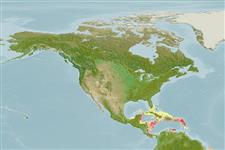
Caribbean: Curaçao, Bonaire and Dominica.
Taille / Poids / Âge
Maturité: Lm ? range ? - ? cm
Max length : 4.7 cm SL mâle / non sexé; (Ref. 109716)
Description synthétique
Clés d'identification | Morphologie | Morphométrie
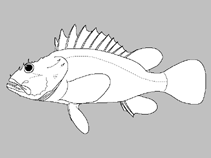
Épines dorsales (Total) : 13; Rayons mous dorsaux (Total) : 8; Épines anales: 3; Rayons mous anaux: 5; Vertèbres: 24. This species is distinguished by the following set of characters: D soft rays 8; pectoral-fin rays 16-17, rays 11-12 (from uppermost ray) are noticeably longer than rest in smallest four type specimens; caudal-fin rays 25-27; vertebrae 8 precaudal + 16 caudal = 24; spines on suborbital ridge 4 (rarely 5); no secondary suborbital ridge spines; 2 prominent round to oblong pores in suborbital sensory canal immediately ventral to suborbital ridge; absence of coronal, interorbital, upper post temporal and postorbital spines; incomplete lateral line, 8-10 pored scales extending from behind supracleithral spine to mid body; cirri associated with
nasal, supraocular, and parietal spines and present on posteroventral projection of lacrimal
and upper left quadrant of the orbit; no cirri associated with postocular, tympanic,
supracleithral, and lower posttemporal spines; relatively elongate body, its depth at origin
of dorsal fin 30-32% SL, depth at caudal peduncle 9-10% SL; when alive, colour bright
orange-red with several reddish-brown bars on posterior portion of trunk, the pectoral fin
with vivid yellow spots interspersed with bright orange-red spots (Ref. 109716).
Body shape (shape guide): fusiform / normal; Cross section: compressed.
Collected on rocky substrata on a vertical rock wall (Ref. 109716).
Cycle de vie et comportement reproducteur
Maturité | Reproduction | Frai | Œufs | Fécondité | Larves
Baldwin, C.C., D.E. Pitassy and D.R. Robertson, 2016. A new deep-reef scorpionfish (Teleostei: Scorpaenidae, Scorpaenodes) from the southern Caribbean with comments on depth distributios and relationships of western Atlantic members of the genus. ZooKeys 606:141-158. (Ref. 109716)
Statut dans la liste rouge de l'IUCN (Ref. 130435: Version 2025-2 (Global))
Menace pour l'homme
Harmless
Utilisations par l'homme
Outils
Articles particuliers
Télécharger en XML
Sources Internet
Estimations basées sur des modèles
Indice de diversité phylogénétique (Réf.
82804): PD
50 = 0.5000 [Uniqueness, from 0.5 = low to 2.0 = high].
Bayesian length-weight: a=0.01288 (0.00626 - 0.02652), b=3.02 (2.85 - 3.19), in cm total length, based on LWR estimates for this (Sub)family-body shape (Ref.
93245).
Niveau trophique (Réf.
69278): 3.3 ±0.5 se; based on size and trophs of closest relatives
Résilience (Réf.
120179): Haut, temps minimum de doublement de population inférieur à 15 mois (Preliminary K or Fecundity.).
Vulnérabilité de la pêche (Ref.
59153): Low vulnerability (10 of 100).
🛈