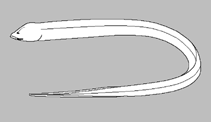
Classification / Noms
Noms communs | Synonymes | Catalog of Fishes(Genre, Espèce) | ITIS | CoL | WoRMS | Cloffa
>
Synbranchiformes (Spiny eels) >
Synbranchidae (Swamp-eels)
Etymology: rongsaw: Name from the Khasi word meaning red, referring to the blood red colour of the species when alive; noun in apposition.
Environnement : milieu / zone climatique / profondeur / gamme de distribution
Écologie
; eau douce pélagique; profondeur 0 - 1 m (Ref. 118582). Subtropical
Asia: Khasi Hills in Meghalaya, India.
Taille / Poids / Âge
Maturité: Lm ? range ? - ? cm
Max length : 17.9 cm TL mâle / non sexé; (Ref. 118582)
Description synthétique
Clés d'identification | Morphologie | Morphométrie
Vertèbres: 161. This species is distinguished from all other synbranchids except Ophisternon infernale,
O. candidum, Monopterus boueti, M. luticolus, M. eapeni, M. roseni, and M. digressus in having tiny eyes which are covered by skin that are barely visible externally and by the lack of skin pigmentation. It differs from the seven species by having 92+69=161 vertebrae (vs. 67+72=139 in Ophisternon infernale, 51-54+109-111=162-163 in O. candidum, 108 + 79-86 = 187-194 in M. boueti, 95-102+98-110=198-208 in M. luticolus, 135+24=159 in M. eapeni, 76+71=147 in M. roseni, and 86-88+80-82=166-170 in M. digressus); differs further from M. boueti and M. luticolus in having the shoulder girdle articulating with the skull, with the posttemporal contacting the epiotic and supracleithrum (vs. cleithrum and supracleithrum posteriorly displaced and the posttemporal separated from the supracleithrum and epiotic) (Ref. 118582).
Body shape (shape guide): eel-like; Cross section: oval.
Obligate air-breathing (Ref. 126274); Collected by soil-digging searches with bladed hoes for fossorial caecilian amphibians; at a depth of ca. 40 cm in moist, rocky soil in a secondary forest, approximately 4 km trekking distance from Double Decker living roots bridge in Nongriat. It was unearthed ca. 50 m from an unnamed stream with some ground vegetation (herbs and bushes) that was cleared before digging (Ref. 118582).
Cycle de vie et comportement reproducteur
Maturité | Reproduction | Frai | Œufs | Fécondité | Larves
Britz, R., D. Sykes, D.J. Grower and R.G. Kamei, 2018. Monopterus rongsaw, a new species of hypogean swamp eel from the Khasi Hills in Northeast India (Teleostei: Synbranchiformes: Synbranchidae). Ichthyol. Explor. Freshwat. 28(4):315-326. (Ref. 118582)
Statut dans la liste rouge de l'IUCN (Ref. 130435: Version 2025-2 (Global))
Menace pour l'homme
Harmless
Utilisations par l'homme
Outils
Articles particuliers
Télécharger en XML
Sources Internet
Estimations basées sur des modèles
Indice de diversité phylogénétique (Réf.
82804): PD
50 = 0.5312 [Uniqueness, from 0.5 = low to 2.0 = high].
Bayesian length-weight: a=0.00085 (0.00040 - 0.00182), b=3.09 (2.90 - 3.28), in cm total length, based on LWR estimates for this (Sub)family-body shape (Ref.
93245).
Niveau trophique (Réf.
69278): 3.2 ±0.3 se; based on size and trophs of closest relatives
Résilience (Réf.
120179): Haut, temps minimum de doublement de population inférieur à 15 mois (Preliminary K or Fecundity.).
Vulnérabilité de la pêche (Ref.
59153): Low vulnerability (10 of 100).
🛈