Classification / Noms
Noms communs | Synonymes | Catalog of Fishes(Genre, Espèce) | ITIS | CoL | WoRMS | Cloffa
>
Perciformes/Serranoidei (Groupers) >
Serranidae (Sea basses: groupers and fairy basslets)
Etymology: Serranus: Latin, serran, serranus, saw and a fish of genus Serranus (Ref. 45335); inexpectatus: Name from Latin meaning unexpected, referring to the surprising find of an undescribed species in the collection of Zoologische Staatssammkung museum.
Environnement : milieu / zone climatique / profondeur / gamme de distribution
Écologie
marin récifal; profondeur 25 - 36 m (Ref. 118671). Tropical
Distribution
Territoires | Zones FAO | Écosystèmes | Occurrences | Carte par point | Introductions | Faunafri
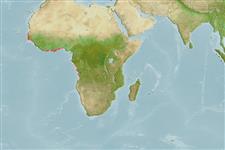
Eastern Central Atlantic: Senegal, Gabon and Angola; and possibly Sierra Leone.
Taille / Poids / Âge
Maturité: Lm ? range ? - ? cm
Max length : 9.2 cm TL mâle / non sexé; (Ref. 118671)
Description synthétique
Clés d'identification | Morphologie | Morphométrie
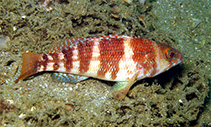
Épines dorsales (Total) : 10 - 1; Rayons mous dorsaux (Total) : 12; Épines anales: 3; Rayons mous anaux: 7. This species is distinguished by the following characters: D X,12; A III, 7; gill rakers 5-7 + 10-11, total = 15-18; pseudobranchial filaments about 22; pored lateral line scales 46; circumpeduncular scales 21; scales below D1 origin 4 and below first segmented dorsal ray 3-3.5; truncate caudal fin with upper lobe slightly pointed and the lower somewhat rounded; dorsal, anal and pectoral fins scaly near base; tube-like anterior nostril with rim low anteriorly but rising to a high narrow flap posteriorly, 4-6 long cirri at distal tip; posterior nostril a simple opening lacking a raised rim; a prominent black blotch distally between dorsal fin spines a and 4; body with 5 broad bands and another over nape, with the band under the 5th to 10th spines descending to belly well removed from the pectoral-fin base and to front of anal fin; the band below anterior rays of soft dorsal fin descends to middle of anal-fin base (Ref. 118671).
Body shape (shape guide): fusiform / normal; Cross section: compressed.
Found in rocky bottoms (Ref. 118671).
Cycle de vie et comportement reproducteur
Maturité | Reproduction | Frai | Œufs | Fécondité | Larves
Iwamoto, T. and P. Wirtz, 2018. A synopsis of the Eastern and Central Atlantic combers of the genus Serranus (Teleostei: Scorpaeniformes: Serranidae). Proc. Calif. Acad. Sci. 65(1):1-39. (Ref. 118671)
Statut dans la liste rouge de l'IUCN (Ref. 130435: Version 2025-2 (Global))
Menace pour l'homme
Harmless
Utilisations par l'homme
Outils
Articles particuliers
Télécharger en XML
Sources Internet
Estimations basées sur des modèles
Indice de diversité phylogénétique (Réf.
82804): PD
50 = 0.5000 [Uniqueness, from 0.5 = low to 2.0 = high].
Bayesian length-weight: a=0.01096 (0.00514 - 0.02340), b=3.05 (2.88 - 3.22), in cm total length, based on LWR estimates for this Genus-body shape (Ref.
93245).
Niveau trophique (Réf.
69278): 3.4 ±0.4 se; based on size and trophs of closest relatives
Résilience (Réf.
120179): Haut, temps minimum de doublement de population inférieur à 15 mois (Preliminary K or Fecundity.).
Vulnérabilité de la pêche (Ref.
59153): Low vulnerability (10 of 100).
🛈