การจำแนกประเภท / ชื่อ
ชื่อสามัญ | ชื่อพ้อง | Catalog of Fishes(สกุล, ชนิด) | ITIS | CoL | WoRMS | Cloffa
>
Cichliformes (Cichlids, convict blennies) >
Cichlidae (Cichlids) > Pseudocrenilabrinae
Etymology: Oreochromis: Latin, aurum = gold + Greek, chromis = a fish, perhaps a perch (Ref. 45335).
สิ่งแวดล้อม : สิ่งแวดล้อม / เขตภูมิอากาศ / ระดับความลึก / ระยะการกระจายสินค้า
นิเวศวิทยา
; น้ำจืด กลุ่มสัตว์หน้าดิน,กลุ่มสัตว์พื้นท้องน้ำ. Tropical
Africa: Malagarasi River and marginal waters of Lake Tanganyika near Kigoma in Tanzania (Ref. 118638) and Burundi (Ref. 54847).
ขนาด / น้ำหนัก / อายุ
วัยเจริญพันธุ์: Lm ? range ? - ? cm
Max length : 27.0 cm TL เพศผู้/กระเทย; (Ref. 118638)
คำอธิบายสั้นๆ
เครื่องมือที่ใช้ในการแยกชนิดสัตว์,สิ่งมีชีวิตออกจากกัน | สัณฐานวิทยา | ความยาวต่างๆ
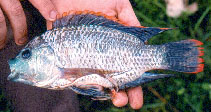
เงี่ยงครีบหลัง (รวม) : 16 - 17; ก้านครีบอ่อนที่หาง (รวม) : 12 - 13; เงี่ยงครีบก้น: 3; ก้านครีบอ่อนที่ก้น: 10 - 12; สัตว์มีกระดูกสันหลัง: 29 - 30. Diagnosis: A large bodied Oreochromis, characterised by a deep body, short snout and 3-4 blotches on the flank coupled with around 6 faint wide vertical bars (Ref. 118638). It is a tasselled species, resembling Oreochromis upembae from which it differs in the following features: mid-lateral blotches present as in O. upembae, caudal fin either without spots or with a few irregularly arranged or in quincunx; caudal rays variously scaly but the inter-radial membranes usually free of scales; vertebrae 29-30; scales in lateral line series 30-32; dorsal spines XVI-XVII, soft rays 12-13; and outer teeth mainly bicuspid, but often including a few tricuspids (Ref. 2). With grey/green fins and flanks; male dorsal and caudal fins have red/orange margins; ripening males reported to be dark green-grey, possibly almost black (Ref. 118638).
Body shape (shape guide): short and / or deep; Cross section: compressed.
Inhabits rivers and swamps (Ref. 4967). It feeds on the soft, flocculent bottom deposits, which consisted of finely divided plant material and many protozoa, bacteria, algae and detritus (Ref. 2, 52307); the young were feeding on fish offal near canoe-landings (Ref. 2). A maternal mouthbrooder (Ref. 118638). A locally important species in artisanal fisheries (Ref. 118638); it contributes to swamp fishery (Ref. 4967). Recorded from aquaculture ponds near Kigoma (Ref. 118638).
วงจรชีวิตและพฤติกรรมการผสมพันธุ์
วัยเจริญพันธุ์ | การสืบพันธุ์ | การวางไข่ | เซลสืบพันธ์ของเพศเมีย(ไข่) | ความดกของไข่ | ตัวอ่อน
A maternal mouthbrooder (Ref. 118638). In various aquarium observations, male builds shallow spawning nests; female deposits eggs in nest; male fertilizes eggs; female takes eggs in mouth; female swallows additional sperms (Ref. 37042).
Genner, M.J., G.F. Turner and B.P. Ngatunga, 2018. A guide to the tilapia fishes of Tanzania. Martin J. Genner, George F. Turner and Benjamin P. Ngatunga, August 2018. 29 p. (Ref. 118638)
สถานะบัญชีแดงของ IUCN (Ref. 130435: Version 2025-2 (Global))
ภัยคุกคามต่อมนุษย์
Harmless
การใช้ของมนุษย์
เครื่องมือ
รายงานพิเศษ
ดาวน์โหลด XML
แหล่งที่มาจากอินเตอร์เน็ต
การประมาณค่าตามแบบจำลอง
ดัชนีความหลากหลายทางวิวัฒนาการ (อ้างอิง
82804): PD
50 = 0.5000 [Uniqueness, from 0.5 = low to 2.0 = high].
Bayesian length-weight: a=0.01905 (0.00846 - 0.04293), b=3.01 (2.82 - 3.20), in cm total length, based on LWR estimates for this (Sub)family-body shape (Ref.
93245).
ความสามารถในการกลับคืนสู่ปกติ (อ้างอิง
120179): ความสูง, เวลาต่ำสุดที่จะทำให้ประชากรเพิ่มขึ้นเป็น 2 เท่าใช้เวลาน้อยกว่า 15 เดือน (Preliminary K or Fecundity.).
ความเสี่ยงต่อการตกปลา (Ref.
59153): Low vulnerability (17 of 100).
🛈