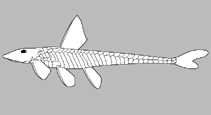
Klassifizierung / Names
Namen | Synonyme | Catalog of Fishes(Gattung, Arten) | ITIS | CoL | WoRMS | Cloffa
>
Siluriformes (Catfishes) >
Loricariidae (Armored catfishes) > Hypostominae
Etymology: Pseudacanthicus: Greek, pseudes = false + Greek, akantha = thorn (Ref. 45335); pitanga: Epithet pitanga derived from Tupi-Guarani, meaning red, in allusion to the color of fins; an adjective.
Umwelt: Milieu / Klimazone / Tiefenbereich / Verbreitungsgebiet
Ökologie
; süßwasser benthopelagisch. Tropical
South America, Brazil
Größe / Gewicht / Alter
Geschlechtsreife: Lm ? range ? - ? cm
Max length : 30.0 cm SL Männchen/unbestimmt; (Ref. 102632)
Kurzbeschreibung
Bestimmungsschlüssel | Morphologie | Morphometrie
Rückenflossenstacheln (insgesamt) : 1; Rückenflossenweichstrahlen (insgesamt) : 9; Afterflossenstacheln: 1; Afterflossenweichstrahlen: 5; Wirbelzahl: 29. Pseudacanthicus pitanga is distinguished from its congener (except P. leopardus) by its color pattern with intense orange to red fins (vs. dark background color with white spots in P. serratus and P. fordii or gray background color with black blotches in P. histrix and P. spinosus);distinguished from P. leopardus by the presence of dark blotches anostomosing to form continuous zigzag bands alongside longitudinal keels; absence of blotches on ventral surface of body; faint blotches on head and all fins with orange to red color on unbranched ray and sometimes on subsequent branched rays (dark blotches conspicuous, never anostomosed; large dark blotches on ventral surface; conspicuous dark blotches on head; and red color restricted to dorsal and caudalfin rays); Pseudacanthicus pitanga can be further diagnosed from congeners by the following combination of osteological characters: contact of sphenotic with 6th infraorbital absent, lateral surface of metapterigoid channel triangular (vs. rounded in remaining species), posterior area of contact between cleithrum and coracoid ventrally expanded (vs. straight in remaining species) (Ref. 102632).
Body shape (shape guide): elongated; Cross section: flattened.
Caught for aquairum use (captured and bred) and exported to several countries, especially to Europe and the USA (Ref. 102632).
Lebenszyklus und Paarungsverhalten
Geschlechtsreife | Fortpflanzung | Ablaichen | Eier | Fruchtbarkeit | Larven
Chamon, C.C., 2015. Pseudacanthicus pitanga: a new species of Ancistrini (Siluriformes: Loricariidae: Hypostominae) from rio Tocantins Basin, North Brazil. Zootaxa 3973(2):309-320. (Ref. 102632)
IUCN Rote Liste Status (Ref. 130435: Version 2025-2 (Global))
Bedrohung für Menschen
Harmless
Nutzung durch Menschen
Fischereien: kommerziell; Aquarium: Kommerziell
Tools
Zusatzinformationen
Download XML
Internet Quellen
Schätzungen auf der Grundlage von Modellen
Phylogenetischer Diversitätsindex (Ref.
82804): PD
50 = 0.5039 [Uniqueness, from 0.5 = low to 2.0 = high].
Bayesian length-weight: a=0.01549 (0.00726 - 0.03306), b=2.96 (2.79 - 3.13), in cm total length, based on LWR estimates for this (Sub)family-body shape (Ref.
93245).
Widerstandsfähigkeit (Ref.
120179): mittel, Verdopplung der Population dauert 1,4 - 4,4 Jahre. (Preliminary K or Fecundity.).
Anfälligkeit der Fischerei (Ref.
59153): Low to moderate vulnerability (27 of 100).
🛈