Classificação / Nomes
Nomes comuns | Sinônimos | Catalog of Fishes(Gênero, Espécies) | ITIS | CoL | WoRMS | Cloffa
>
Characiformes (Characins) >
Curimatidae (Toothless characins)
Etymology: Cyphocharax: Greek, kyphos = curved, humpback + Greek, charax = a marine fish without identification (Ref. 45335); boiadeiro: Named for one of the paratype localities, the rio Boiadeiro, located near municipality of Alto Araguaia, Mato Grosso, Brazil. Named also after the boiadeiros (cowboys in English and vaqueros in Spanish), cattle handlers mounted on horseback who perform multiple ranch-related tasks. Boiadeiros from central Brazil has preserved their classic traditions and influenced regional lifestyles, food and music. A noun in apposition.
Meio ambiente: milieu / Zona climática / intervalo de profundidade / faixa de distribuição
Ecologia
; Água doce bentopelágico. Tropical
South America: Rio Araguaia, Amazon basin in central Brazil.
Tamanho / Peso / Idade
Maturidade: Lm ? range ? - ? cm
Max length : 6.1 cm SL macho/indeterminado; (Ref. 117339)
Descrição suscinta
Chaves de identificação | Morfologia | Morfometria
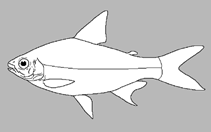
Raios dorsais (total) : 12; Raios anais : 10 - 11; Vértebras: 28 - 29. Cyphocharax boiadeiro is distinguished from all members of the genus, with the exception of C. saladensis, C. signatus and C. spilotus, by having a distinct longitudinal dark stripe running from supracleithrum to the caudal peduncle, stripe interrupted in some specimens, and with a gradual fading of that pigmentation at the vertical line through insertion of the adipose fin to anterior margin of the dark mark on the caudal peduncle (vs. such pigmentation pattern absent). It differs from C. saladensis by having the dark patch of pigmentation restricted to the midlateral surface of the caudal peduncle in specimens longer than 4.0 cm SL (vs. dark patch of pigmentation on caudal peduncle more elongate and rounded, extending anteriorly to vertical line through or anterior to adipose fin in specimens longer than 4.0 cm SL); from C. signatus by having 13-16 rays in pectoral fin (vs. 10-12), anal-fin rays not elongated(vs. relatively elongated) and the caudal peduncle not shortened (vs. caudal peduncle relatively short); and from C. spilotus by having nine branched rays in dorsal fin (vs. 10-12 branched rays). It is distinct from all congeners, except C. aninha, C. gangamon, C. punctatus, C. saladensis, C. signatus, and C. vexillapinnus, by having a truncate laterosensory system that results in specimens with incomplete pored scales that increase in larger specimens (vs. laterosensory system developed with complete lateral line). It is further distinguished from C. laticlavius, C. modestus and C. naegelii by having a rounded to horizontally elongated patch of dark pigmentation restricted to the midlateral surface of the caudal peduncle (vs. prolongation of the dark stripe of the midlateral surface of body into the caudal peduncle). It can be separated from C. helleri, C. multilineatus and C. pantostictus by the presence of a single dark stripe along the midlateral surface of the body (vs. multiple series of longitudinal dark stripes or spot rows running between scale rows in the midlateral surface of the body). It differs also from C. biocellatus, C. jagunco, C. lundi, C. punctatus, C. vanderi and C. voga by having a well-defined dark stripe (vs. presence of two or more dark spots along the lateral surface of body) (Ref. 117339).
Body shape (shape guide): fusiform / normal.
Ciclo de vida ou comportamento de acasalamento
Maturidade | Reprodução | Desova | Ovos | Fecundidade | Larvas
Melo, B.F., 2017. Cyphocharax boiadeiro, a new species from the upper rio Araguaia, Amazon basin, Brazil (Characiformes: Curimatidae). Zootaxa 4247(2):114-120. (Ref. 117339)
Status na Lista Vermelha da UICN (Ref. 130435: Version 2025-2 (Global))
Ameaça para os humanos
Harmless
Uso pelos humanos
Ferramentas
Relatórios especiais
Baixar XML
Fontes da internet
Estimativas baseadas em modelos
Índice de diversidade filogenética (Ref.
82804): PD
50 = 0.5000 [Uniqueness, from 0.5 = low to 2.0 = high].
Bayesian length-weight: a=0.01445 (0.00642 - 0.03257), b=3.02 (2.84 - 3.20), in cm total length, based on LWR estimates for this Genus-body shape (Ref.
93245).
Resiliência (Ref.
120179): Elevada, tempo mínimo de duplicação da população menor que 15 meses (Preliminary K or Fecundity.).
Vulnerabilidade da pesca (Ref.
59153): Low vulnerability (10 of 100).
🛈