Clasificación / Nombres
Nombres comunes | Sinónimos | Catalog of Fishes(Género, Especie) | ITIS | CoL | WoRMS | Cloffa
>
Gobiiformes (Gobies) >
Gobiidae (Gobies) > Gobiinae
Etymology: Glossogobius: Greek, glossa = tongue + Latin, gobius = gudgeon (Ref. 45335); sentaniensis: Named for the type locality, Lake Sentani (Ref. 103536).
Entorno: milieu / zona climática / rango de profundidad / gama de distribución
Ecología
; agua dulce bentopelágico. Tropical
Oceania, Papua New Guinea (Ref. 103536).
Tamaño / Peso / Edad
Madurez: Lm ? range ? - ? cm
Max length : 14.4 cm SL macho / no sexado; (Ref. 103536); 14.0 cm SL (female)
Descripción breve
Claves de identificación | Morfología | Morfometría
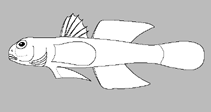
Espinas dorsales (total) : 7; Radios blandos dorsales (total) : 9; Espinas anales: 1; Radios blandos anales: 8; Vértebra: 27. Diagnosis: preoperculum without a spine; mental fraenum indistinct, covered by sensory papillae; mouth large; reaching to below a point between anterior pupil and mideye; jaws forming an angle of 30-35° with body axis; upper margin of upper jaw in line with mideye; cheeks tapering; interorbital narrow, much less than eye; predorsal area scaled forward to eyes; cheek naked; operculum patch of scales dorsally; pectoral base covered by small scales; prepelvic area largely covered with embedded scales, sometimes with thin naked area anteriorly; belly fully scaled; 1st dorsal fin with spines 2-6 extending beyond other spines when fin depressed; 1st dorsal fin without black spot posteriorly; pelvic fin thin and oval, much longer than wide; reaching just short of anus; 2nd dorsal rays I,9; anal rays I,8; pectoral rays usually 19; longitudinal scale count 31-35; predorsal scale count 23-31; transverse scale count (TRB) 11.5-12.5; gill rakers on outer face of 1st arch 1+1+6-9; lower gill rakers on outer face of 2nd arch 8-9; branched caudal rays 13-14, usually 14; vertebrae 11+16=27(4*); papillae: line 1 (before nasal pore) composed of 2 rows of papillae posteriorly, 1 anteriorly; line 2 (between nasal pores) composed of single row of papillae, continuous across snout; line 5 (suborbital) composed of single row of papillae joining line 7 below anterior margin of eye; line 6 (suborbital branch) absent; lines 7, 9, 10 (LL cheek rows) each composed of single row of papillae, reaching to posterior end of preoperculum; line 8 and 11 (LT row) reaching to near end of preoperculum; line 12 (Outer POP-mandibular) composed of single row of papillae, with an arch at posterior end of jaws and continuous with papillae line posteriorly; line 13 (Inner POP-mandibular) composed of 2 or 3 rows of papillae; line 20 (opercular VT) composed of single row of papillae, with multiple branches ventrally; line 21 (Upper opercular OT) composed of single row of papillae, line gently curved; line 22 (Lower opercular OT) short and composed of single row of papillae, with several ventral branches; several vertical papillae rows on belly; a single curved line anteriorly on most body scales (often obscure dorsally and posteriorly) (Ref. 103536).
Body shape (shape guide): elongated; Cross section: compressed.
Ciclo vital y comportamiento de apareamiento
Madurez | Reproducción | Puesta | Huevos | Fecundidad | Larva
Hoese, D.F. and G.R. Allen, 2015. Descriptions of three new species of Glossogobius (Teleostei: Gobiidae) from New Guinea. Zootaxa 3986(2):201-216. (Ref. 103536)
Situación en la Lista Roja de la UICN (Ref. 130435: Version 2025-2 (Global))
Amenaza para el ser humano
Harmless
Usos humanos
Herramientas
Informes especiales
Descargar XML
Fuentes de Internet
Estimaciones basadas en modelos
Índice de diversidad filogenética (Referencia
82804): PD
50 = 0.5000 [Uniqueness, from 0.5 = low to 2.0 = high].
Bayesian length-weight: a=0.00741 (0.00347 - 0.01582), b=3.09 (2.91 - 3.27), in cm total length, based on LWR estimates for this (Sub)family-body shape (Ref.
93245).
Nivel trófico (Referencia
69278): 3.6 ±0.4 se; based on size and trophs of closest relatives
Resiliencia (Referencia
120179): Alto, población duplicada en un tiempo mínimo inferior a 15 meses (Preliminary K or Fecundity.).
Vulnerabilidad pesquera (Ref.
59153): Low vulnerability (10 of 100).
🛈