Classificação / Nomes
Nomes comuns | Sinónimos | Catalog of Fishes(Género, Espécies) | ITIS | CoL | WoRMS | Cloffa
>
Cypriniformes (Carps) >
Cyprinidae (Minnows or carps) > Torinae
Etymology: Hypselobarbus: Greek, hypselos = high + Latin, barbus =barbel (Ref. 45335).
Eponymy: A toponym referring to the village of Kushavali in the Western Ghats of India, where the Kali River (type locality) originates. (Ref. 128868), visit book page.
Ambiente: milieu / zona climática / intervalo de profundidade / gama de distribuição
Ecologia
; Água doce bentopelágico. Tropical
Asia: Kali River, Karnataka, India.
Tamanho / Peso / Idade
Maturidade: Lm ? range ? - ? cm
Max length : 31.0 cm SL macho/indeterminado; (Ref. 119237)
Descrição breve
Chaves de identificação | Morfologia | Morfometria
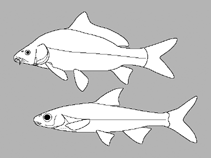
Raios dorsais moles (total) : 13; Raios anais moles: 8. Hypselobarbus kushavali is distinguished from other congeners except H. pulchellus based on the lateral-line scale count of 31-32. It can be diagnosed from H. pulchellus by the lack of a lateral band (vs. presence). It differs from H. dobsoni and H. jerdoni by the lack of fin coloration (vs. the tips of the dorsal and caudal fins are black in H. jerdoni and H. dobsoni). It can be diagnosed from H. dobsoni in having 6.5 upper transverse scale rows (vs. 5.5), 4.5 lateral line to pelvic scale rows (vs. 3.5), 26 circumferential scale rows (vs. 24), and the morphometric characters of greater distance between origin of dorsal fin to origin of anal fin (33.68-36.24 vs. 30.53-31.40 %SL), greater body depth (40.19-42.38 vs. 33.18-37.64 %SL) and wider inter-orbital width (46.65-49.10 vs. 38.52-41.80 % HL). It is distinguished from H. jerdoni in having 31-32 scales on lateral line (vs. 27-29), 26 circumferential scale rows (vs. 23-24) and the morphometric characters of shorter caudal fin length (22.01-26.12 vs. 34.96-37.80 % SL) and greater interorbital width (46.65-49.10 vs. 35.73-40.01 % HL). It can be differentiated from H. bicolor in having 31-32 scales on lateral line (vs. 35-37), 13 circumpeduncular scale rows (vs. 16) and the morphometric character of a greater distance between dorsal-fin origin and pelvic-fin insertion (37.69-41.10 vs. 26.37-30.37 %SL) (Ref. 119237)
Body shape (shape guide): fusiform / normal.
Inhabits rivers, preferring deep pools and riffles with slow to moderately fast current and substrate mostly composed of large boulders (Ref. 119237).
Ciclo de vida e comportamento de acasalamento
Maturidade | Reprodução | Desova | Ovos | Fecundidade | Larvas
Arunachalam, M., S. Chinnaraja, P. Sivakumar and R.L. Mayden, 2016. Description of a new species of large barb of the genus Hypselobarbus (Cypriniformes: Cyprinidae) from Kali River, Karnataka region of Western Ghats, peninsular India. Iran. J. Ichthyol. 3(4): 266-274. (Ref. 119237)
Categoria na Lista Vermelha da IUCN (Ref. 130435: Version 2025-2 (Global))
Ameaça para o homem
Harmless
Utilização humana
Ferramentas
Relatórios especiais
Descarregue XML
Fontes da internet
Estimativas baseadas em modelos
Índice de diversidade filogenética (Ref.
82804): PD
50 = 0.5000 [Uniqueness, from 0.5 = low to 2.0 = high].
Bayesian length-weight: a=0.00955 (0.00430 - 0.02123), b=3.02 (2.83 - 3.21), in cm total length, based on LWR estimates for this (Sub)family-body shape (Ref.
93245).
Resiliência (Ref.
120179): Médio, tempo mínimo de duplicação da população 1,4 - 4,4 anos (Preliminary K or Fecundity.).
Vulnerabilidade da pesca (Ref.
59153): Low to moderate vulnerability (28 of 100).
🛈