Classification / Noms
Noms communs | Synonymes | Catalog of Fishes(Genre, Espèce) | ITIS | CoL | WoRMS | Cloffa
>
Siluriformes (Catfishes) >
Sisoridae (Sisorid catfishes) > Glyptosterninae
Etymology: Oreoglanis: Greek, oreos = mountain+Greek, glanis = Latin, aurum = gold + Greek, glanis = a fish that can eat the bait without touching the hook; a cat fish (Ref. 45335); pangenensis: Named for the typ locality, the Pange Riverthe; an adjective (Ref. 103418).
Environnement : milieu / zone climatique / profondeur / gamme de distribution
Écologie
; eau douce benthopélagique. Tropical
Asia: currently known only from its type locality at the Pange River, Lower Subansiri District, Arunachal Pradesh, northeastern India (Ref. 103418).
Taille / Poids / Âge
Maturité: Lm ? range ? - ? cm
Max length : 7.7 cm SL mâle / non sexé; (Ref. 103418)
Description synthétique
Clés d'identification | Morphologie | Morphométrie
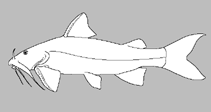
Rayons mous dorsaux (Total) : 7; Rayons mous anaux: 5. Diagnosis: distinguished from all its congeners by the presence of 2 (vs. 1) types of projections on the ventroposterior margin of the maxillary barbel: the proximal 3rd with lobulate projections and distal 2/3 with laciniate (vs. only entire margin or only crenulate, laciniate, lobulate, fimbriate, or villiform projections); further diagnosed by the combination of the following characters: lower lip with an entire margin and a distinct median notch, an emarginate caudal fin, a dark brown streak on the outer margin of each caudal-fin lobe, distance between posterior end of pectoral-fin base and pelvic-fin origin 11.5 % SL, caudal peduncle depth 5.3 % SL, dorsal-to-adipose distance 21.1 % SL, interorbital width 25 % HL, anal-fin base 2.9 % SL, upper and lower first principal caudal-fin rays 12.6 and 15.0 % SL, and a rounded maxillary barbel tip (Ref. 103418).
Body shape (shape guide): elongated.
Cycle de vie et comportement reproducteur
Maturité | Reproduction | Frai | Œufs | Fécondité | Larves
Sinha, B. and L. Tamang, 2015. Oreoglanis pangenensis, a new species of torrent catfish from Arunachal Pradesh, India (Siluriformes: Sisoridae). Ichthyol. Explor. Freshwat. 25(4):331-338. (Ref. 103418)
Statut dans la liste rouge de l'IUCN (Ref. 130435: Version 2025-2 (Global))
Menace pour l'homme
Harmless
Utilisations par l'homme
Outils
Articles particuliers
Télécharger en XML
Sources Internet
Estimations basées sur des modèles
Indice de diversité phylogénétique (Réf.
82804): PD
50 = 0.5000 [Uniqueness, from 0.5 = low to 2.0 = high].
Bayesian length-weight: a=0.00603 (0.00269 - 0.01352), b=3.08 (2.88 - 3.28), in cm total length, based on LWR estimates for this (Sub)family-body shape (Ref.
93245).
Niveau trophique (Réf.
69278): 3.1 ±0.4 se; based on size and trophs of closest relatives
Résilience (Réf.
120179): Milieu, temps minimum de doublement de population : 1,4 à 4,4 années (Preliminary K or Fecundity.).
Vulnérabilité de la pêche (Ref.
59153): Low vulnerability (10 of 100).
🛈