Classification / Noms
Noms communs | Synonymes | Catalog of Fishes(Genre, Espèce) | ITIS | CoL | WoRMS | Cloffa
>
Cypriniformes (Carps) >
Nemacheilidae (Brook loaches)
Etymology: Schistura: Greek, schizein = to divide + Greek, oura = tail; an allusion to forked caudal fins (Ref. 45335); scyphovecteta: The specific epithet is derived from Latin scypho (goblet) and vectes (bars); a compound name in reference to the presence of goblet shaped bars on the body; and formed as an adjective.
Environnement : milieu / zone climatique / profondeur / gamme de distribution
Écologie
; eau douce démersal. Tropical
Asia: Kaoao and Kolchaw Rivers in Mizoram, India.
Taille / Poids / Âge
Maturité: Lm ? range ? - ? cm
Max length : 3.8 cm SL mâle / non sexé; (Ref. 94459); 3.9 cm SL (female)
Description synthétique
Clés d'identification | Morphologie | Morphométrie
Rayons mous dorsaux (Total) : 11; Rayons mous anaux: 8. Schistura scyphovecteta can be diagnosed from all congeners by the combination of
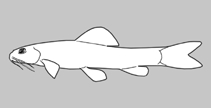
the following characters: lateral line with six dark brown saddles, each one continuing to the flank, forming globular-shaped bars overlaying a hazy brown stripe; a complete lateral line; dorsal-fin base with two black spots; an incomplete black basicaudal bar; absence of median notch on the lower jaw; and males with a suborbital flap. This new species is similar to its congener S. menanensis from the Mae Nam Nan drainage, Thailand by possessing a longitudinal brown stripe along the lateral line superposed by the bar pattern, but differs from that species in
having a complete lateral line (vs. incomplete lateral line), dorsal fin with 7½ branched rays (vs. 8½), pectoral fin with 10 branched rays (vs. 9), and the absence of a median notch on the lower jaw (vs. presence) (Ref. 94459).
Body shape (shape guide): elongated.
This species usually inhabits streams with swift current, among big boulders and rocks in southern Mizoram. Topotypic specimens of this species were taken from Kaoao River near New Serkawr village, among big boulders, in fast current. Two paratypes were also caught from the Kolchaw River near Kolchaw. This fish co-occurs with the following species: Olyra sp. (Bagridae); Devario sp., Pethia sp., Garra sp. (Cyprinidae); Schistura nebeshwari (Nemacheilidae); and Glyptothorax jayarami (Sisoridae) (Ref. 94459).
Cycle de vie et comportement reproducteur
Maturité | Reproduction | Frai | Œufs | Fécondité | Larves
Lokeshwor, Y. and W. Vishwanath, 2013. Two new species of stone loaches of the genus Schistura from the Koladyne basin Mizoram, India (Teleostei: Cobitoidei: Nemacheilidae). Zootaxa 3731(4):561-576. (Ref. 94459)
Statut dans la liste rouge de l'IUCN (Ref. 130435: Version 2025-2 (Global))
Menace pour l'homme
Harmless
Utilisations par l'homme
Outils
Articles particuliers
Télécharger en XML
Sources Internet
Estimations basées sur des modèles
Indice de diversité phylogénétique (Réf.
82804): PD
50 = 0.5000 [Uniqueness, from 0.5 = low to 2.0 = high].
Bayesian length-weight: a=0.00708 (0.00323 - 0.01553), b=3.03 (2.86 - 3.20), in cm total length, based on LWR estimates for this Genus-body shape (Ref.
93245).
Niveau trophique (Réf.
69278): 3.0 ±0.3 se; based on size and trophs of closest relatives
Résilience (Réf.
120179): Haut, temps minimum de doublement de population inférieur à 15 mois (Preliminary K or Fecundity.).
Vulnérabilité de la pêche (Ref.
59153): Low vulnerability (10 of 100).
🛈