Classificazione / Nomi
Nomi Comuni | Sinonimi | Catalog of Fishes(Genere, Specie) | ITIS | CoL | WoRMS | Cloffa
>
Cichliformes (Cichlids, convict blennies) >
Cichlidae (Cichlids) > Pseudocrenilabrinae
Etymology: Maylandia: In honour of Hans J. Mayland, German ictiologist (Ref. 45335); flavicauda: The name flavicauda is a noun in apposition and derives from the Latin flavus meaning 'yellow' and cauda meaining 'tail', and refers to the yellow tail of territorial males (Ref. 119465).
Eponymy: Hans-Joachim Mayland (1928–2004) was a German ichthyologist, aquarist, photographer and writer. [...] (Ref. 128868), visit book page.
Ambiente: milieu / zona climatica / distribuzione batimetrica / gamma di distribuzione
Ecologia
; acqua dolce benthopelagico. Tropical
Africa: Lake Malawi in Malawi (Ref. 119465).
Dimensione / Peso / Età
Maturità: Lm ? range ? - ? cm
Max length : 10.1 cm SL maschio/sesso non determinato; (Ref. 119465)
Breve descrizione
Chiavi di identificazione | Morfologia | Morfometria
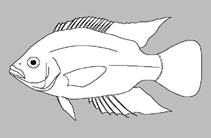
Spine dorsali (totale) : 17 - 19; Raggi dorsali molli (totale) : 8 - 10; Spine anali: 2 - 3; Raggi anali molli: 8 - 9. Diagnosis: The presence of bicuspid teeth in the outer rows on both the upper and lower jaws and a moderately sloped vomer with a swollen rostral tip place this species in Maylandia (Ref. 119465). Male and female M. flavicauda are distinguished by an elongate body, body depth 23.6-28.5% of standard length, from all other species in Maylandia, body depth 28.8-40.8% of standard length, except M. tarakiki, body depth 25.8-32.9% of standard length, and M. usisyae, body depth 25.9-30.6% of standard length (Ref. 119465). It is distinguished from M. usisyae by a deeper preorbital bone, preorbital depth 18.0-26.9% of head length, and a longer snout, snout length 34.3-47.3% of head length, which are 17.6-21.2% and 32.0-37.6% in head length in M. usisyae respectively; based on the colour pattern, males of M. flavicauda possess 5-6 black lateral bars, black pelvic fins, a black anal fin, a yellow caudal fin, and a black dorsal fin with yellow/orange spots distally; males of M. usisyae have a yellow dorsal fin with a black submarginal band, a yellow pelvic fin and a yellow anal fin with a black leading edge; males of M. tarakikihave 7-9 lateral bars, and gray-blue/dark gray caudal fin (Ref. 119465). Females of M. flavicauda can be distinguished from those of M. tarakiki by a bluish/brown ground colouration without lateral bars; in female M. tarakiki, the ground colour is light brown with blue center-flank scales and dark brown lateral bars; based on colouration alone, females of M. flavicauda cannot reliably be distinguished from those of M. usisyae (Ref. 119465). Maylandia flavicauda also possess a relatively smaller eye than M. tarakiki, horizontal eye diameter 20.5-30.6% of head length vs. 27.2-36.3% in M. tarakiki (Ref. 119465).
Body shape (shape guide): elongated.
Ciclo vitale e comportamento di accoppiamento
Maturità | Riproduzione | Deposizione | Uova | Fecondità | Larve
Li, S., A.F. Konings and J.R. Stauffer Jr., 2016. A revision of the Pseudotropheus elongatus species group (Teleostei: Cichlidae) with description of a new genus and seven new species. Zootaxa 4168(2):353-381. (Ref. 119465)
Stato della Lista Rossa IUCN (Ref. 130435: Version 2025-2 (Global))
Minaccia per l'uomo
Harmless
Usi umani
Strumenti
Rapporti speciali
Scarica XML
Fonti Internet
Stime basate su modelli
Indice di diversità filogenetica (Fonte Biblio.
82804): PD
50 = 0.5000 [Uniqueness, from 0.5 = low to 2.0 = high].
Bayesian length-weight: a=0.00389 (0.00180 - 0.00842), b=3.12 (2.94 - 3.30), in cm total length, based on all LWR estimates for this body shape (Ref.
93245).
Resilienza (Fonte Biblio.
120179): Alto, tempo minimo di raddoppiamento della popolazione meno di 15 mesi (Preliminary K or Fecundity.).
Vulnerabilità della pesca (Ref.
59153): Low vulnerability (10 of 100).
🛈