Classificação / Nomes
Nomes comuns | Sinônimos | Catalog of Fishes(Gênero, Espécies) | ITIS | CoL | WoRMS | Cloffa
>
Cichliformes (Cichlids, convict blennies) >
Cichlidae (Cichlids) > Pseudocrenilabrinae
Etymology: Maylandia: In honour of Hans J. Mayland, German ictiologist (Ref. 45335); usisyae: The specific epithet usisyae is the genitive of Usisya, the village near which the type specimens were collected (Ref. 119465).
Eponymy: Hans-Joachim Mayland (1928–2004) was a German ichthyologist, aquarist, photographer and writer. [...] This is a toponym referring to Usisya, a village on Lake Malawi near the type locality. (Ref. 128868), visit book page.
Meio ambiente: milieu / Zona climática / intervalo de profundidade / faixa de distribuição
Ecologia
; Água doce bentopelágico. Tropical
Africa: Lake Malawi in Malawi (Ref. 119465).
Tamanho / Peso / Idade
Maturidade: Lm ? range ? - ? cm
Max length : 7.5 cm SL macho/indeterminado; (Ref. 119465)
Descrição suscinta
Chaves de identificação | Morfologia | Morfometria
Espinhos dorsais (total) : 17 - 18; Raios dorsais (total) : 8 - 9; Espinhos anais: 3; Raios anais : 7 - 8. Diagnosis: The presence of bicuspid teeth in the outer rows on both the upper and lower jaws and a moderately sloped vomer block with a swollen rostral tip place this species in Maylandia (Ref. 119465). Male and female M. usisyae are distinguished by an elongate body, body depth 25.9-30.6% of standard length, from all other species in Maylandia, body depth 28.8-40.8% of standard length, except M. tarakiki, body depth 25.8-32.9% of standard length, and M. flavicauda, body depth 23.6-28.5% of standard length (Ref. 119465). It differs from M. tarakiki by a smaller eye, vertical eye diameter 23.1-28.1% of head length vs. 30.2-36.5% in M. tarakiki; and a shorter lower jaw length, lower jaw length 29.9-33.4% of head length vs. 34.8-38.9% on M. tarakiki (Ref. 119465). Based on the colour pattern, male M. usisyae possess a yellow dorsal fin with a black submarginal band, yellow pelvic fins and yellow anal fin with a black leading edge; male M. flavicauda possess black pelvic and anal fins, and a black dorsal fin with yellow/orange spots distally; the ground colouration of male M. flavicauda is blue with 2 light/purple interorbital bars vs. yellow with 2 white/light blue interorbital bars in male M. usisyae; females of M. usisyae cannot reliably be distinguished by colour from those of M. flavicauda; Maylandia flavicauda also possess a deeper preorbital bone, preorbital depth 18.0-26.9% of head length, and a longer snout, snout length 34.3-47.3% of head length, which are 17.6-21.2% and 32.0-37.6% in M. usisyae respectively (Ref. 119465).
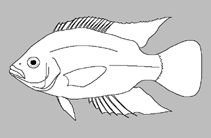
Body shape (shape guide): elongated.
Ciclo de vida ou comportamento de acasalamento
Maturidade | Reprodução | Desova | Ovos | Fecundidade | Larvas
Li, S., A.F. Konings and J.R. Stauffer Jr., 2016. A revision of the Pseudotropheus elongatus species group (Teleostei: Cichlidae) with description of a new genus and seven new species. Zootaxa 4168(2):353-381. (Ref. 119465)
Status na Lista Vermelha da UICN (Ref. 130435: Version 2025-2 (Global))
Ameaça para os humanos
Harmless
Uso pelos humanos
Ferramentas
Relatórios especiais
Baixar XML
Fontes da internet
Estimativas baseadas em modelos
Índice de diversidade filogenética (Ref.
82804): PD
50 = 0.5000 [Uniqueness, from 0.5 = low to 2.0 = high].
Bayesian length-weight: a=0.00389 (0.00180 - 0.00842), b=3.12 (2.94 - 3.30), in cm total length, based on all LWR estimates for this body shape (Ref.
93245).
Nível Trófico (Ref.
69278): 2.3 ±0.1 se; based on size and trophs of closest relatives
Resiliência (Ref.
120179): Elevada, tempo mínimo de duplicação da população menor que 15 meses (Preliminary K or Fecundity.).
Vulnerabilidade da pesca (Ref.
59153): Low vulnerability (10 of 100).
🛈