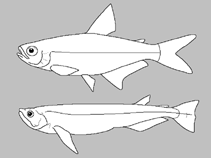
Classificação / Nomes
Nomes comuns | Sinónimos | Catalog of Fishes(Género, Espécies) | ITIS | CoL | WoRMS | Cloffa
>
Characiformes (Characins) >
Characidae (Characins; tetras) > Cheirodontinae
Etymology: Serrapinnus: Latin, serran, serranus, saw and a fish of genus Serranus + Latin, pinna = spiny, thorn (Ref. 45335); zanatae: Named zanatae in honor to Angela Maria Zanata, due to her contribution to our knowledge of Neotropical freshwater fishes, and for collecting the new species. A noun in genitive.
Eponymy: Dr Angela Maria Zanata is a zoologist and ichthyologist at the Federal University of Bahia, Brazil (2007). [...] (Ref. 128868), visit book page.
Ambiente: milieu / zona climática / intervalo de profundidade / gama de distribuição
Ecologia
; Água doce bentopelágico. Tropical
South America: currently known to inhabit the upper and middle portions of the rio Jequitinhonha basin, Minas Gerais State, southeastern region of Brazil (Ref. 119705).
Tamanho / Peso / Idade
Maturidade: Lm ? range ? - ? cm
Max length : 3.9 cm SL macho/indeterminado; (Ref. 119705)
Descrição breve
Chaves de identificação | Morfologia | Morfometria
Raios dorsais moles (total) : 10 - 11; Raios anais moles: 19 - 23. Serrapinnus zanatae is distinguished from its congeners by the following characters: premaxillary teeth with 7-9 cusps (vs. 10-12 cusps in S. gracilis and S. littoris, and 3-5 cusps in S. microdon and S. potiguar; spatulate and parallel ventral procurrent caudal-fin rays (vs. scimitar-shaped procurrent caudal-fin rays arranged in a semi-circle in S. aster and S. potiguar); incomplete lateral line (vs. complete lateral line in S. heterodon, sometimes also complete in S. sterbai and S. tocantinensis; dorsal fin without markings (vs. black pigmentation on the anterior and proximal border of the dorsal fin in S. notomelas and a faint black blotch on the distal half of the dorsal fin in S. microdon and S. heterodon); dark longitudinal stripe extending from the region below the dorsal fin to the caudal peduncle (vs. dark longitudinal stripe extending from the region anterior to the pseudotympanum to the caudal peduncle in S. sterbai); abdomen without distinctive marks ( vs. abdomen with a black spot on the posteroventral region in S. kriegi); absence of fins rays extended as filaments (vs. unbranched dorsal-, pelvic- and anal-fin rays extended as filaments in mature males in S. tocantinensis); 11-13 ventral procurrent caudal-fin rays (vs. 13-16 in S. calliurus, 14-16 in S. kriegi, 17-19 in S. lucindai, and 13-16 in S. micropterus); 16-19 branched anal-fin rays (vs. 19-22 in S. calliurus); 33-36 scales on longitudinal series (vs. 31-32 in S. micropterus); caudal-fin spot oval and horizontally elongated not extending to dorsal and ventral margins of the caudal peduncle (vs. caudal spot usually lozenge, vertically elongated, reaching the dorsal and ventral margins of the caudal peduncle in S. calliurus and S. piaba (Ref. 119705)).
Body shape (shape guide): elongated; Cross section: compressed.
Ciclo de vida e comportamento de acasalamento
Maturidade | Reprodução | Desova | Ovos | Fecundidade | Larvas
Jerep, F.C., P. Camelier and L.R. Malabarba, 2016. Serrapinnus zanatae, a new species from the rio Jequitinhonha basin, Minas Gerais State, Brazil (Teleostei: Characidae: Cheirodontinae). Ichthyol. Explor. Freshwat. 26(4):289-298. (Ref. 119705)
Categoria na Lista Vermelha da IUCN (Ref. 130435: Version 2025-2 (Global))
Ameaça para o homem
Harmless
Utilização humana
Pescarias: sem interesse
Ferramentas
Relatórios especiais
Descarregue XML
Fontes da internet
Estimativas baseadas em modelos
Índice de diversidade filogenética (Ref.
82804): PD
50 = 0.5000 [Uniqueness, from 0.5 = low to 2.0 = high].
Bayesian length-weight: a=0.01072 (0.00446 - 0.02572), b=3.07 (2.88 - 3.26), in cm total length, based on LWR estimates for this Genus-body shape (Ref.
93245).
Nível Trófico (Ref.
69278): 2.5 ±0.5 se; based on size and trophs of closest relatives
Vulnerabilidade da pesca (Ref.
59153): Low vulnerability (10 of 100).
🛈