Classification / Noms
Noms communs | Synonymes | Catalog of Fishes(Genre, Espèce) | ITIS | CoL | WoRMS | Cloffa
>
Cichliformes (Cichlids, convict blennies) >
Cichlidae (Cichlids) > Pseudocrenilabrinae
Etymology: Trematocranus: Greek, trematos = hole + Greek, kranion = skull (Ref. 45335); pachychilus: The specific name, pachychilus, means thick-lip and is derived from the Greek words παχυς, meaning fat, adipose, plump, and χειλος, meaning lip, edge, with reference to the diagnostic character, the thick lips (Ref. 120598).
Environnement : milieu / zone climatique / profondeur / gamme de distribution
Écologie
; eau douce benthopélagique. Tropical
Africa: Jafua Bay, Lake Malawi in Mozambique (Ref. 120598).
Taille / Poids / Âge
Maturité: Lm ? range ? - ? cm
Max length : 15.5 cm SL mâle / non sexé; (Ref. 120598)
Description synthétique
Clés d'identification | Morphologie | Morphométrie
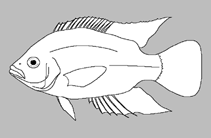
Épines dorsales (Total) : 15 - 16; Rayons mous dorsaux (Total) : 11 - 12; Rayons mous anaux: 8 - 10; Vertèbres: 31 - 32. Diagnosis: Trematocranus pachychilus is clearly distinct from all other known species of the genus by its thick lips (Ref. 120598). It can further be distinguished from T. labifer by its molariform pharyngeal dentition while the latter has slender teeth on the lower pharyngeal jaw (Ref. 120598). In T. placodon lips are usually very small; while T. pachychilus has a rather concave head, as in T. microstoma, T. placodon has a more distinct convex head; in both T. pachychilus and T. placodon, the smaller specimens have a straighter head profile; coincidentally, in two large specimens of T. placodon the head is slightly concave; the teeth of T. pachychilus are less broad, more densely spaced and slightly less numerous, 36-47 vs. 41-57, than in T. placodon; Trematocranus pachychilus has more upper lateral line scales, 22-24 vs. 19-22, and more dorsal fin rays, 11-12 vs. 9-11, than T. placodon; the pharyngeal bones of T. pachychilus are less developed than in T. placodon; they are shallower, 9.4-10.4% of head length vs. 13.8-16.8%, narrower, 29.7-33.2% of head length vs. 36.1-48.7%, and shorter, 21.8-30.8% of head length vs. 29.8-35.9%, than those of T. placodon (Ref. 120598). The dentigerous area is also narrower than in T. placodon, 21.9-24.4% of head length vs. 24.2-27.5%; both species have large, molariform pharyngeal teeth, although in T. pachychilus the lateral teeth are smaller and more numerous than in T. placodon; the number of teeth on the posterior pharyngeal row in T. pachychilus is higher than in T. placodon, 23-27 vs. 11-23 (Ref. 120598). In T. microstoma the lips are intermediate; the snout of T. pachychilus is shorter than that of T. microstoma, 34.8-40.9% of head length vs. 38.0-42.4%; Trematocranus pachychilus has bicuspid oral teeth on the outer rows while T. microstoma has slender unicuspid teeth; it has fewer inner teeth rows, 3-5 vs. 6-8 on the lower jaw than T. microstoma; the lachrymal depth is clearly shorter than in T. microstoma, 22.9-29.7% of head length vs. 29.3-32.0%, while the eye diameter is larger, 25.2-29.5% of head length vs. 21.2-25.5%; the pharyngeal bones are more developed in T. pachychilus than in T. microstoma; the dentigerous area of T. pachychilus is wider than in T. microstoma, 21.9-24.4% of head length vs. 18.8-23.6%; the dentition of the lower pharyngeal bone is similar in both species, with the median teeth enlarged and the lateral teeth small and numerous (Ref. 120598).
Body shape (shape guide): fusiform / normal.
Thick and fleshy lips are associated with rocky habitats in cichlids, since fish feeding between rocks use their lips as a seal to be able to suck out their prey from crevices and as protection against sharp rocks; but since all specimens were found in bottom trawls over soft substrates, the association of the new species with rocky habitats is unsure (Ref. 120598). Shell fragments of snails were observed in the stomachs of some specimens (Ref. 120598).
Cycle de vie et comportement reproducteur
Maturité | Reproduction | Frai | Œufs | Fécondité | Larves
Dierickx, K., M. Hanssens, B. Rusuwa and J. Snoeks, 2018. Trematocranus pachychilus, a new endemic cichlid from Lake Malawi (Teleostei, Cichlidae). ZooKeys 743:153-166. (Ref. 120598)
Statut dans la liste rouge de l'IUCN (Ref. 130435: Version 2025-2 (Global))
Menace pour l'homme
Harmless
Utilisations par l'homme
Pêcheries: sans intérêt
Outils
Articles particuliers
Télécharger en XML
Sources Internet
Estimations basées sur des modèles
Indice de diversité phylogénétique (Réf.
82804): PD
50 = 0.5625 [Uniqueness, from 0.5 = low to 2.0 = high].
Bayesian length-weight: a=0.01905 (0.00846 - 0.04293), b=3.01 (2.82 - 3.20), in cm total length, based on LWR estimates for this (Sub)family-body shape (Ref.
93245).
Niveau trophique (Réf.
69278): 3.3 ±0.6 se; based on size and trophs of closest relatives
Résilience (Réf.
120179): Haut, temps minimum de doublement de population inférieur à 15 mois (Preliminary K or Fecundity.).
Vulnérabilité de la pêche (Ref.
59153): Low vulnerability (10 of 100).
🛈