>
Perciformes/Serranoidei (Groupers) >
Anthiadidae (Fairy basslets or Streamer basses)
Etymology: Luzonichthys: Taken from Luzon, an island in Philippines + greek, ichthys = fish (Ref. 45335); seaver: Named for the Seaver family, for their support (Seaver Institute) to marine research; noun in apposition.
Entorno: milieu / zona climática / rango de profundidad / gama de distribución
Ecología
marino asociado a arrecife; rango de profundidad 81 - 100 m (Ref. 116681). Tropical
Western Central Pacific: Micronesia (Caroline Is., Pohnpei) and French Polynesia (Moorea).
Tamaño / Peso / Edad
Madurez: Lm ? range ? - ? cm
Max length : 4.6 cm SL macho / no sexado; (Ref. 116681)
Descripción breve
Claves de identificación | Morfología | Morfometría
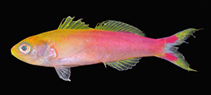
Espinas dorsales (total) : 10; Radios blandos dorsales (total) : 16; Espinas anales: 3; Radios blandos anales: 7. This species is distinguished by the following characters: D X,16; A III,7; pectoral rays 19-21; lateral line scales 63-54; gill rakers 8+18-19; moderately elongated body with depth 3.86-4.6 in SL; head length 3.41-3.54 in SL; snout 3.86-4.0 in HL; forked caudal fin with filamentous rays, caudal concavity 8.36-8.5 in SL; pectoral fins 3.86-4.38 in SL; pelvic fins 5.67-6.54 in SL. Colour when alive: head excluding operculum is predominately yellow (many scales with yellow margins and pink centers), yellow extending posteriorly on upper half of body from a line starting approximately from the tip of the opercular flap and top of pectoral fins to the eighth dorsal ray, then fading to bright pink posteriorly; from operculum to lower half of body is salmon pink; pale pectoral and pelvic fins, dorsal fins yellow with pink bases at the rear dorsal rays anal fin rays yellow with pale membranes; upper and lower base of caudal fin pink, extending posteriorly to approximately halfway to the tips; the center of base of caudal fin is white, then fading to pale; posterior half of caudal fin is yellow, lower base of caudal peduncle with yellow band (Ref. 116681).
Body shape (shape guide): elongated; Cross section: compressed.
Minimum depth reported taken from Ref. 128797.
Ciclo vital y comportamiento de apareamiento
Madurez | Reproducción | Puesta | Huevos | Fecundidad | Larva
Copus, J.M., C. Ka'apu-Lyons and R.L. Pyle, 2015. Luzonichthys seaver, a new species of Anthiinae (Perciformes, Serranidae) from Pohnpei Micronesia. Biodiversity Data Journal 3:e4902. (Ref. 116681)
Situación en la Lista Roja de la UICN (Ref. 130435: Version 2025-2 (Global))
Amenaza para el ser humano
Harmless
Usos humanos
Herramientas
Informes especiales
Descargar XML
Fuentes de Internet
Estimaciones basadas en modelos
Índice de diversidad filogenética (Referencia
82804): PD
50 = 0.5039 [Uniqueness, from 0.5 = low to 2.0 = high].
Bayesian length-weight: a=0.00389 (0.00180 - 0.00842), b=3.12 (2.94 - 3.30), in cm total length, based on all LWR estimates for this body shape (Ref.
93245).
Nivel trófico (Referencia
69278): 3.4 ±0.4 se; based on size and trophs of closest relatives
Resiliencia (Referencia
120179): Alto, población duplicada en un tiempo mínimo inferior a 15 meses (Preliminary K or Fecundity.).
Vulnerabilidad pesquera (Ref.
59153): Low vulnerability (10 of 100).
🛈