Classification / Noms
Noms communs | Synonymes | Catalog of Fishes(Genre, Espèce) | ITIS | CoL | WoRMS | Cloffa
>
Cyprinodontiformes (Rivulines, killifishes and live bearers) >
Procatopodidae (African lampeyes) > Procatopodinae
Etymology: petnehazyi: The species epithet is given in honour of Gábor Petneházy who accompanied Béla Nagy collecting killifishes during several field trips in Africa, including the one in Democratic Republic of Congo in 2016, and collected the species at the type locality during the second field trip; a noun in genitive case (Ref. 122040).
Environnement : milieu / zone climatique / profondeur / gamme de distribution
Écologie
; eau douce pélagique; pH range: 6.3 - 7.2. Tropical; 25°C - 28°C (Ref. 122040)
Africa: Tshipokokolo system, Upper Lufira drainage, tributary of Congo River in Democratic Republic of Congo (Ref. 122040).
Taille / Poids / Âge
Maturité: Lm ? range ? - ? cm
Max length : 1.9 cm SL mâle / non sexé; (Ref. 122040)
Description synthétique
Clés d'identification | Morphologie | Morphométrie
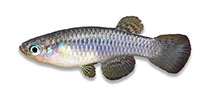
Épines dorsales (Total) : 0; Rayons mous dorsaux (Total) : 8 - 10; Épines anales: 0; Rayons mous anaux: 14 - 16. Diagnosis: Micropanchax petnehazyi is distinguished from all other Micropanchax species, with the exception of M. hutereaui, by the combination of following characters in male colouration: dark transverse markings on the median fins; reticulate markings on the side; as well as the structure of the cephalic sensory system in both sexes characterised by a supraorbital canal composed of two short, discontinuous grooves containing exposed neuromasts; postorbital and preopercular sensory systems tubular with pores (Ref. 122040). Furthermore, M. petnehazyi is distinguished from M. hutereaui by the following unique combination of characters in males: dorsal and anal fins with faint brown stripes perpendicular to fin rays vs. curved stripes in M. hutereaui; anal fin with a faint brown margin and without a light submarginal band vs. with dark brown margin and with light submarginal band; caudal fin with irregular vertical markings forming a reticulate pattern vs. narrow vertical bands; as well as, in both sexes, preorbital sensory system in a shallow canal with three exposed neuromasts vs. tubular with three pores; mandibular sensory system in open groove with small exposed neuromasts vs. tubular with pores; smaller body depth at pelvic-fin origin 25.3-28.7% of standard length vs. 30.0-32.3%; smaller interorbital width 34-40% of standard length vs. 47-51%; larger postorbital length 45-46% of head length vs. 38-43%; smaller suborbital depth 11-14% of head length vs. 21-25%; and larger caudal peduncle length 1.4 times of its depth vs. 1.0-1.1 (Ref. 122040).
Body shape (shape guide): fusiform / normal; Cross section: compressed.
Currently known from ephemeral pools of the Tshipokokolo system (Ref. 122040). The water of the habitat was transparent with the bottom of the pool well visible although the water was slightly brownish in colour (Ref. 22040).
Cycle de vie et comportement reproducteur
Maturité | Reproduction | Frai | Œufs | Fécondité | Larves
Nagy, B. and E. Vreven, 2018. Micropanchax petnehazyi, a new species of lampeye cyprinodontiform from the Lufira drainage, Democratic Republic of Congo (Cyprinodontiformes: Poeciliidae). Ichthyol. Explor. Freshwat. 28(2):157-169, (Ref. 122040)
Statut dans la liste rouge de l'IUCN (Ref. 130435: Version 2025-2 (Global))
Menacé (EN) (B1ab(iii)+2ab(iii)); Date assessed: 14 January 2023
Menace pour l'homme
Harmless
Utilisations par l'homme
Pêcheries: sans intérêt
Outils
Articles particuliers
Télécharger en XML
Sources Internet
Estimations basées sur des modèles
Indice de diversité phylogénétique (Réf.
82804): PD
50 = 0.5000 [Uniqueness, from 0.5 = low to 2.0 = high].
Bayesian length-weight: a=0.00562 (0.00224 - 0.01412), b=3.07 (2.85 - 3.29), in cm total length, based on LWR estimates for this (Sub)family-body shape (Ref.
93245).
Niveau trophique (Réf.
69278): 3.0 ±0.3 se; based on size and trophs of closest relatives
Vulnérabilité de la pêche (Ref.
59153): Low vulnerability (10 of 100).
🛈