Classification / Noms
Noms communs | Synonymes | Catalog of Fishes(Genre, Espèce) | ITIS | CoL | WoRMS | Cloffa
Environnement : milieu / zone climatique / profondeur / gamme de distribution
Écologie
marin récifal; profondeur 115 - 150 m (Ref. 59379). Tropical
Distribution
Territoires | Zones FAO | Écosystèmes | Occurrences | Carte par point | Introductions | Faunafri
Western Pacific: Palau and Micronesia (Pohnpei).
Taille / Poids / Âge
Maturité: Lm ? range ? - ? cm
Max length : 6.9 cm SL mâle / non sexé; (Ref. 59379)
Description synthétique
Clés d'identification | Morphologie | Morphométrie
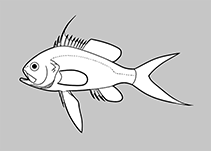
Épines dorsales (Total) : 10; Rayons mous dorsaux (Total) : 16 - 17; Épines anales: 3; Rayons mous anaux: 8; Vertèbres: 26. This species is distinguished by the following characters: D X, 16-17, the fourth or fifth dorsal spine the longest; anal-fin soft rays 8; pored lateral-line scales 33-34; head 2.3-2.9 in SL; body depth 2.6 in SL. Colouration of males when alive: head and body rose-pink and crossed by 4 bright yellow stripes with the third continuing as a bright red stripe with magenta edges along the middle of the body, becoming yellow centered on base of caudal fin; dorsal fin with a very broad middle yellow stripe, its margin is magenta; anal-fin base colored like body anteriorly and grading broadly to magenta posteriorly; pelvic fins yellow, except the last two rays which is magenta; eye magenta with an uneven ring of yellow around its pupil; immature and presumed female are yellow with irregu¬lar, near-vertical, wavy red lines following scale margins, its anal fin magenta anteriorly, grading posteriorly to purple, with a greenish yellow streak and pelvic fins bright magenta (Ref. 59379).
Cross section: compressed.
This species was observed and collected along steep limestone coral-reef drop-offs at depths from 115–150 m. The paratypes were collected along a small rocky crevice near the entrance to a cave, but other individuals were seen in similar habitats not in association with caves. Most individuals have been observed in groups consisting of one apparent male and several apparent females and juveniles (Ref. 59379).
Cycle de vie et comportement reproducteur
Maturité | Reproduction | Frai | Œufs | Fécondité | Larves
Pyle, R., J.L. Earle and B.D. Greene, 2008. Five new species of the damselfish genus Chromis (Perciformes: Labroidei: Pomacentridae) from deep coral reefs in the tropical western Pacific. Zootaxa 1671:3-31. (Ref. 59379)
Statut dans la liste rouge de l'IUCN (Ref. 130435: Version 2025-2 (Global))
Menace pour l'homme
Harmless
Utilisations par l'homme
Outils
Articles particuliers
Télécharger en XML
Sources Internet
Estimations basées sur des modèles
Indice de diversité phylogénétique (Réf.
82804): PD
50 = 0.5312 [Uniqueness, from 0.5 = low to 2.0 = high].
Bayesian length-weight: a=0.02512 (0.00978 - 0.06451), b=2.98 (2.75 - 3.21), in cm total length, based on LWR estimates for this (Sub)family-body shape (Ref.
93245).
Niveau trophique (Réf.
69278): 3.3 ±0.4 se; based on size and trophs of closest relatives
Résilience (Réf.
120179): Haut, temps minimum de doublement de population inférieur à 15 mois (Preliminary K or Fecundity.).
Vulnérabilité de la pêche (Ref.
59153): Low vulnerability (10 of 100).
🛈