Klassifizierung / Names
Namen | Synonyme | Catalog of Fishes(Gattung, Arten) | ITIS | CoL | WoRMS | Cloffa
>
Gobiiformes (Gobies) >
Gobiidae (Gobies) > Gobiinae
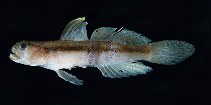
Etymology: balteata: Name from Latin 'balteatus' meaning ‘with a shoulder-band or baldric’, referring to the dark band around the center of the body; feminine adjective.
Eponymy: Dr George Sprague Myers (1905–1985), an American ichthyologist, bio-geographer and herpetologist, was Professor Emeritus of Biological Sciences at Stanford, California. [...] (Ref. 128868), visit book page.
Umwelt: Milieu / Klimazone / Tiefenbereich / Verbreitungsgebiet
Ökologie
seewasser riff-verbunden; tiefenbereich ? - 54 m (Ref. 118499). Tropical
Western Central Pacific: Solomon Is.
Größe / Gewicht / Alter
Geschlechtsreife: Lm ? range ? - ? cm
Max length : 4.9 cm SL Männchen/unbestimmt; (Ref. 118499)
Kurzbeschreibung
Bestimmungsschlüssel | Morphologie | Morphometrie
Rückenflossenstacheln (insgesamt) : 7; Rückenflossenweichstrahlen (insgesamt) : 10; Afterflossenstacheln: 1; Afterflossenweichstrahlen: 9. This species is distinguished by the following characters: body crossed by a wide gray bar at midbody and a dark longitudinal stripe extending midlaterally along center of body from head to caudal-fin base; first dorsal fin triangular in shape, of moderate height, 23% SL, the anterior spines with yellow margin, not filamentous, and with yellow spots on basal membranes; second dorsal fin with large diffuse yellow spots on all membranes; the postorbital side of head with distinct narrow yellow lines; distal end of maxilla is yellow; gill membranes fused together and to isthmus at ventral midline; caudal-fin length 37% SL; dorsal-fin elements VI-I,10; anal-fin elements I,9; pectoral-fin rays 17; predorsal midline with 20 scales; scales in longitudinal series 62; gill rakers 4+13 (Ref. .118499).
Cross section: oval.
The holotype was speared near a burrow in silty sand that appeared to have been made by an alpheid shrimp (although no shrimp was seen) (Ref. 118499).
Lebenszyklus und Paarungsverhalten
Geschlechtsreife | Fortpflanzung | Ablaichen | Eier | Fruchtbarkeit | Larven
Greenfield, D.W. and J.E. Randall, 2018. Myersina balteata, a new shrimp-associated goby (Teleostei: Gobiidae) from Guadalcanal, Solomon Islands. J. Ocean Sci. Found. 30:90-99. (Ref. 118499)
IUCN Rote Liste Status (Ref. 130435: Version 2025-2 (Global))
Bedrohung für Menschen
Harmless
Nutzung durch Menschen
Tools
Zusatzinformationen
Download XML
Internet Quellen
Schätzungen auf der Grundlage von Modellen
Phylogenetischer Diversitätsindex (Ref.
82804): PD
50 = 0.5010 [Uniqueness, from 0.5 = low to 2.0 = high].
Bayesian length-weight: a=0.00741 (0.00347 - 0.01582), b=3.09 (2.91 - 3.27), in cm total length, based on LWR estimates for this (Sub)family-body shape (Ref.
93245).
Trophische Ebene (Ref.
69278): 3.2 ±0.3 se; based on size and trophs of closest relatives
Widerstandsfähigkeit (Ref.
120179): hoch, Verdopplung der Population dauert weniger als 15 Monate. (Preliminary K or Fecundity.).
Anfälligkeit der Fischerei (Ref.
59153): Low vulnerability (10 of 100).
🛈