This website uses cookies to enhance your browsing experience and ensure the functionality of our site. For more detailed information about the types of cookies we use and how we protect your privacy, please visit our Privacy Information page.
×
Cookie Settings
This website uses different types of cookies to enhance your experience. Please select your preferences below:
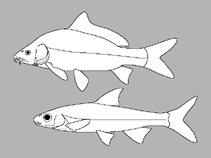
No image available for this species; drawing shows typical species in Cyprinidae.
分類 / 名稱 俗名 | 同種異名 | Catalog of Fishes(屬, 種) | ITIS | CoL | WoRMS | Cloffa
Teleostei > Cypriniformes (Carps) 鯉形目 (Carps) > Cyprinidae (Minnows or carps) 鯉科 (Minnows or carps) > Smiliogastrinae
Etymology: Enteromius:Greek, enteron = intestine + Greek, myo, mys = muscle (Ref. 45335); yardiensis:The species name yardiensis refers to Lake Yardi, where the species is abundant (Ref. 121538).
背棘 (總數) : 0; 背的軟條 (總數) : 11 - 12; 臀棘: 0; 臀鰭軟條: 9; 脊椎骨: 33 - 34. Diagnosis: Enteromius yardiensis belongs to a phenotypic group characterised by small size and the last unbranched dorsal-fin ray thickened and serrated (Ref. 121538). It is readily distinguished from its Ethiopian congeners by three unique specialisations: the absence of the anterior barbel, the absence of the medial branch of the supraorbital cephalic canal and few, 1-3, commonly 2, scale rows between lateral line and anus (Ref. 121538). It further differs by posterior barbel usually shorter than half eye diameter; eye large, its diameter 24-34% of head length; snout short and pointed; lateral line complete and strongly curved; scales in the lateral series 32-35; few transversal scale rows between lateral line and pelvic-fin base, 1-3; scale rows between dorsal- and pelvic-fin origins 7-10; often four unbranched dorsal-fin rays; few branched pectoral-fin rays, commonly 12 or 13; 17-18 abdominal vertebrae; 10-12 predorsal abdominal vertebrae; and 6-9 vertebrae between first pterygiophores of dorsal and anal fins (Ref. 121538).
Body shape (shape guide): fusiform / normal; Cross section: compressed.
Found in shallow shoreline habitats of the main channel of Awash River, deep stretches of side channels, stagnant water bodies of the adjacent floodplain, and in the shoreline of the lakes (Ref. 121538). A preference for structured habitats with aquatic plants, woody debris, dense river bank vegetation and fine substrate, sand and finer fractions, was noted; a pronounced difference between wet and dry season is characteristic for the area Ref. 121538). Water is usually turbid and water temperature ranged from 26.1°C to 31.9°C (Ref. 121538). Gut contents contained unidentifiable fine organic detritus and remains of planktonic crustaceans but also nematodes, remains of terrestrial arthropods, diatoms, larger plant material, seeds, and wood debris, and some non-organic material (Ref. 121538).
Englmaier, G.K., G. Tesfaye and N.G. Bogutskaya, 2020. A new species of Enteromius (Actinopterygii, Cyprinidae, Smiliogastrinae) from the Awash River, Ethiopia, and the re-establishment of E. akakianus. ZooKeys 902:107-150. (Ref. 121538)
系統發育多樣性指數 (參考文獻 82804): PD50 = 0.5000 [Uniqueness, from 0.5 = low to 2.0 = high].
Bayesian length-weight: a=0.00603 (0.00282 - 0.01286), b=3.06 (2.87 - 3.25), in cm total length, based on LWR estimates for this (Sub)family-body shape (Ref. 93245).
營養階層 (參考文獻 69278): 3.0 ±0.3 se; based on size and trophs of closest relatives
回復力 (參考文獻 120179): 高度, 族群倍增時間少於 15個月 (Preliminary K or Fecundity.).
釣魚的脆弱性 (Ref. 59153): Low vulnerability (10 of 100). 🛈