Classificação / Nomes
Nomes comuns | Sinônimos | Catalog of Fishes(Gênero, Espécies) | ITIS | CoL | WoRMS | Cloffa
>
Cyprinodontiformes (Rivulines, killifishes and live bearers) >
Nothobranchiidae (African rivulines)
Etymology: Nothobranchius: Greek, nothos = false + Greek, brangchia = gill (Ref. 45335); sonjae: The specific name is named in honour of Sonja Hengstler, co-collector of the type specimens of this species; she is an active participant and plays an essential role in Nothobranchius collecting trips in Africa together with her husband, the renowned killifish enthusiast, Holger Hengstler; a noun in genitive (Ref. 122068).
Eponymy: Sonja Hengstler, who helped collect the holotype, is the wife of “renowned killifish enthusiast” Holger Hengstler. (See also Hengstler) (Ref. 128868), visit book page.
Meio ambiente: milieu / Zona climática / intervalo de profundidade / faixa de distribuição
Ecologia
; Água doce bentopelágico. Tropical
Africa: seasonal pools and marshes associated with Malagarasi River drainage and Moame River in west-central Tanzania (Ref. 122068).
Tamanho / Peso / Idade
Maturidade: Lm ? range ? - ? cm
Max length : 4.4 cm SL macho/indeterminado; (Ref. 122068); 1.9 cm SL (female)
Descrição suscinta
Chaves de identificação | Morfologia | Morfometria
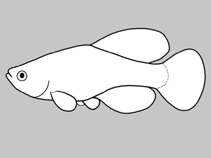
Espinhos dorsais (total) : 0; Raios dorsais (total) : 15 - 18; Espinhos anais: 0; Raios anais : 18 - 19. Diagnosis: Nothobranchius sonjae is distinguished from all other species of the genus by the following characters in males: body colouration light blue to blue-green with red-brown, brown or grey scale margins and a golden-brown to grey stripe on the dorsal scale row between nape and dorsal-fin origin; anal fin light blue-grey to yellow-grey with irregular red to red-brown spots proximally, followed by a narrow brown submedial band, a slender yellow medial band and a broad black distal band; caudal fin yellow-brown, grey-brown, blue-grey or grey, with red-brown, brown, dark grey or red spots; some populations with radiating red stripes, the density of which varies from moderate to highly dense such that in the latter cases the basal, proximal and medial zones may appear dominantly a deep red; distal zone comprises a slender to broad semi-translucent dark grey to black distal band; pelvic fin light blue-grey to yellow-grey, with broad yellow medial band and narrow black and blue distal margin (Ref. 122068). Furthermore, it differs from the other members of the Nothobranchius taeniopygus group in central and western Tanzania by a head length of 25.8-27.0% of standard length vs. 27.3-34.6%; and caudal peduncle length 153-159% of its depth vs. 119-149% and 160-169%, respectively (Ref. 122068).
Body shape (shape guide): fusiform / normal; Cross section: compressed.
Found in seasonal pools and marshes (Ref. 122068).
Ciclo de vida ou comportamento de acasalamento
Maturidade | Reprodução | Desova | Ovos | Fecundidade | Larvas
Watters, B.R., B. Nagy, P.D.W. van der Merwe, F.P.D. Cotteril and D.U. Bellstedt, 2019. Review of the Nothobranchius taeniopygus species group from central and western Tanzania with descriptions of five new species and redescription of Nothobranchius taeniopygus (Teleostei: Nothobranchiidae). Ichthyol. Explor. Freshwat. 29(3):239-278. (Ref. 122068)
Status na Lista Vermelha da UICN (Ref. 130435: Version 2025-2 (Global))
Ameaça para os humanos
Harmless
Uso pelos humanos
Ferramentas
Relatórios especiais
Baixar XML
Fontes da internet
Estimativas baseadas em modelos
Índice de diversidade filogenética (Ref.
82804): PD
50 = 0.5000 [Uniqueness, from 0.5 = low to 2.0 = high].
Bayesian length-weight: a=0.00603 (0.00250 - 0.01453), b=3.13 (2.93 - 3.33), in cm total length, based on LWR estimates for this (Sub)family-body shape (Ref.
93245).
Nível Trófico (Ref.
69278): 3.2 ±0.4 se; based on size and trophs of closest relatives
Vulnerabilidade da pesca (Ref.
59153): Low vulnerability (10 of 100).
🛈