Klassificering / Namn
Populärnamn | synonymer | Catalog of Fishes(Släkte, Arter) | ITIS | CoL | WoRMS | Cloffa
>
Cichliformes (Cichlids, convict blennies) >
Cichlidae (Cichlids) > Pseudocrenilabrinae
Etymology: Orthochromis: Greek, ortho = straight + Greek, chromis = a fish, perhaps a perch (Ref. 45335); katumbii: The species is named after Mr. Moïse Katumbi who supported part of the 2015 ichthyological reasearch field expedition of the Mbisa Congo project in Katanga province of the Democratic Republic of the Congo, who himself is a great fish enthusiast; some specimens of this new species were collected on his farm "Ferme de Futuka" (Ref. 122085).
Eponymy: Moïse Katumbi (d: 1964) is a businessman and former Governer of Katanga (Democratic Republic of the Congo). [...] (Ref. 128868), visit book page.
Miljö: miljö / Klimatzon / djupintervall / distributionsområde
Ekologi
; sötvatten bentopelagisk; pH range: 7.7 - 8.0. Tropical; 19°C - 24°C (Ref. 122085)
Africa: Kiswishi River and Mambilima Falls on Luapula River, Congo River basin, in Democratic Republic of the Congo and Zambia (Ref. 122085).
Storlek / Vikt / Ålder
Könsmognad: Lm ? range ? - ? cm
Max length : 8.6 cm SL hane/ej könsbestämd; (Ref. 122085)
Kort beskrivning
Bestämningsnycklar | Morfologi | Morfometri
Taggstrålar i ryggfenan (totalt) : 16 - 18; Mjukstrålar i ryggfenan (totalt) : 9 - 10; Taggstrålar i analfenan: 3; Mjukstrålar i analfenan: 7 - 9; Ryggkotor: 30 - 31. Diagnosis: Orthochromis katumbii is distinguished from all Malagarasi-Orthochromis species including O. sp. 'Igamba', except O. mazimeroensis and O. rubrolabialis by having more scale rows on cheek, 1-4 vs. 0; further it is distinguished from O. kasuluensis, O. mosoensis, and O. rufuguensis by having more scales in lower lateral line, 10-13 vs. 7-9, and furthermore from O. kasuluensis by having fewer dorsal-fin rays, 7-9 vs. 10; from O. mosoensis by having more scales on operculum, 2-3 vs. 0-1; from O. uvinzae by having fewer scales between upper lateral line and dorsal-fin origin, 4-5 vs. 6-8, by having fewer dorsal-fin spines, 16-18 vs. 19-20, and it is distinguished in position of pterygiophore supporting last dorsal-fin spine, vertebral count 15-17 vs. 18-19 (Ref. 122085). From O. mazimeroensis it is distinguished by having more horizontal line scales, 30-31 vs. 26-28, more abdominal vertebrae, 14-15 vs. 12-13, and more total vertebrae, 30-31 vs. 26-28; it is distinguished from O. rubrolabialis by having more ceratobranchial gill rakers, 7-9 vs. 5-6, and total gill raker, 10-13 vs. 8-9; from O. stormsi by having more caudal vertebrae, 16-17 vs. 14-15, more total vertebrae, 30-31 vs. 28-29, more horizontal line scales, 30-31 vs. 26-28, and fewer scales between upper lateral line and dorsal-fin origin, 4-5 vs. 6-9; from O. polyacanthus by having more series of scales on cheek, 1-4 vs. 0; from O. torrenticola by having fewer anal-fin spines, 3 vs. 4 (Ref. 122085). Meristic values of O. katumbii overlap with those of O. kalungwishiensis but is distinguished by differences in colour and melanin patterns, e.g. nostril stripe on O. katumbii not extending to interorbital stripe vs. extending in O. kalungwishiensis; operculum yellowish-grey in O. katumbii vs. reddish-brownish in O. kalungwishiensis; vertical bars crossing midlateral band more pronounced in O. kalungwishiensis (Ref. 122085). Meristic values of O. katumbii overlap with those of O. luongoensis but is distinguished by ratio length/depth of caudal peduncle, 1.6-.9 vs. 2.0-2.4; in addition O. katumbii tends to have fewer vertical bars on flank, 7-9 vs. 9-12 (Ref. 122085). Meristic values of O. katumbii overlap with those of O. machadoi but is distinguished by smaller body depth, 22.4-27.7% of standard length vs. 30.0-32.2%; it is distinguished from Schwetzochromis neodon by having more circumpeduncular scales, 16 vs. 12, and fewer dorsal-fin rays, 9-10 vs. 11-12; it differs from Haplochromis snoeksi by having more scales on lower lateral line, 10-13 vs. 9, more abdominal vertebrae, 14-15 vs. 13, fewer caudal vertebrae, 16 vs. 17, more anal-fin rays, 7-9 vs. 5-6, and more total gill rakers, 10-13 vs. 9, in position pterygiophore supporting last anal-fin spine, vertebral count 15-16 vs. 13, and by having hypurals 3 and 4 fused vs. clearly separated or fused with distinctly visible seam; it differs from Haplochromis bakongo and H. moeruensis by having more horizontal line scales, 30-31 vs. 26-28, more caudal vertebrae, 16-17 vs. 12-15, and more total vertebrae, 30-31 vs. 26-29; additionally, O. katumbii differs from H. bakongo by having more dorsal fin spines, 16-18 vs. 14-15, by having hypurals 1 and 2 and hypurals 3 and 4 fused vs. clearly separated or fused with distinctly visible seam, and by postion of pterygiophore supporting last dorsal-fin spine, vertebral count 15-17 vs. 13-14; and from H. moeruensis by having more scales on upper lateral line, 21-24 vs. 19-20; it differs from Haplochromis vanheusdeni by having more horizontal line scales, 30-31 vs. 26-29 (Ref. 122085). It is distinguished from O. kimpala by having more horizontal line scales, 30-31 vs. 27-29, fewer scales between upper lateral line and dorsal-fin origin, 4-5 vs. 6-7; from O. indermauri by having more horizontal line scales, 30-31 vs. 25-29, caudal vertebrae, 16-17 vs. 14-15, total vertebrae, 30-31 vs. 28-29, and by having hypurals 1 and 2 fused vs. clearly separated or fused with very distinctly visible seam; meristic values of O. katumbii overlap with those of O. mporokoso but is distinguished by having fewer vertical bars on flank, 7-9 vs. 13-15, and in head mask pattern, i.e. no cheek stripe present vs. present in O. mporokoso; meristic values of O. katumbii overlap with those of O. gecki but is distinguished by having a wider interorbital, 15.5-21.7% of head length vs. 9.6-12.9%, moreover O. katumbii lacks eggspots on anal fin vs. present in O. gecki (Ref. 122085).
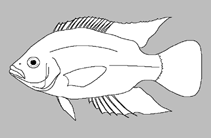
Body shape (shape guide): fusiform / normal.
A benthic-rheophilic maternal mouthbrooder with clutch sizes, in captivity, of between 25 and 30 eggs (Ref. 122085).
Livscykel och parningsbeteende
Könsmognad | Reproduktion | Lek | Ägg | Fekunditet | Larver
Schedel, F.D.B., E.J.W.M.N. Vreven, B. Katemo Manda, E. Abwe, A. Chocha Manda and U.K. Schliewen, 2018. Description of five new rheophilic Orthochromis species (Teleostei: Cichlidae) from the Upper Congo drainage in Zambia and the Democratic Republic of the Congo. Zootaxa 4461(3):301-349. (Ref. 122085)
Status på IUCN:s rödlista (Ref. 130435: Version 2025-2 (Global))
Hot mot människor
Harmless
Mänskliga användningsområden
Verktyg
Särskilda rapporter
Ladda ner XML
Internet-källor
Uppskattningar baserade på modeller
Index för fylogenetisk mångfald (Ref.
82804): PD
50 = 0.5000 [Uniqueness, from 0.5 = low to 2.0 = high].
Bayesian length-weight: a=0.00389 (0.00180 - 0.00842), b=3.12 (2.94 - 3.30), in cm total length, based on all LWR estimates for this body shape (Ref.
93245).
Resiliens (Ref.
120179): Hög, lägsta populationsfördubblingstid mindre än 15 månader (Preliminary K or Fecundity.).
Sårbarhet i fisket (Ref.
59153): Low vulnerability (10 of 100).
🛈