Classificação / Nomes
Nomes comuns | Sinônimos | Catalog of Fishes(Gênero, Espécies) | ITIS | CoL | WoRMS | Cloffa
>
Characiformes (Characins) >
Distichodontidae (Distichodus)
Etymology: Distichodus: Greek, di = two + Greek, stix, stichos = line, row (Ref. 45335); polli: The species is named in honour of Prof. Max Poll (1908-1991) in recognition of his outstanding work on the freshwater fishes from Africa in general and from the Congo basin in particular; during his field trip on the Bushimaie River in 1956, Poll collected the two largest specimens of Distichodus polli, the smaller of which has been designated as the holotype (Ref. 122090).
Eponymy: Dr Max Fernand Leon Poll (1908–1991) was a Belgian ichthyologist, and ‘connoisseur of the fish fauna’. [...] (Ref. 128868), visit book page.
Meio ambiente: milieu / Zona climática / intervalo de profundidade / faixa de distribuição
Ecologia
; Água doce bentopelágico; pH range: 7.2 - 7.5. Tropical; 25°C - 29°C (Ref. 122090)
Africa: Kasai River drainage and Lovoi River, Congo River basin in Democratic Republic of the Congo (Ref. 122090).
Tamanho / Peso / Idade
Maturidade: Lm ? range ? - ? cm
Max length : 16.5 cm SL macho/indeterminado; (Ref. 122090)
Descrição suscinta
Chaves de identificação | Morfologia | Morfometria
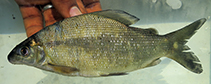
Espinhos dorsais (total) : 0; Raios dorsais (total) : 23 - 27; Espinhos anais: 0; Raios anais : 11 - 14. Diagnosis: Distichodus polli can easily be distinguished from D. affinin, D. altus, D. decemmaculatus, D. hypostomatus, D. kolleri, D. noboli, D. notospilus and D. teugelsi, by its higher number of lateral line scales anterior to the hypural joint, 63-70 vs. 37-49, except 53-60 in D. hypostomatus; and from D. engycephalus and D. nefasch by its lower number of lateral line scales, 63-70 vs. 73-86 in D. engycephalus and 80-110 in D. nefasch (Ref. 122090). It can be distinguished from D. antonii, D. brevipinnis, D. lusosso, D. mossambicus, D. petersii and D. rostratus by its inferior mouth vs. terminal; moreover, it can be distinguished from D. antonii by its number of scales between the dorsal fin and the lateral line, 13-16 vs. 10-12, around the caudal peduncle, 23-26 vs. 20-23, and on the lateral line anterior to the hypural joint, 63-70 vs. 52-64; it is further distinguished from D. lusosso by its short snout vs. elongate, and a brown-greenish overall life colour pattern with 11-16 black vertical bars on the flanks on specimens smaller than about 165 mm standard length, vs. orange to reddish life body colouration with 6-8 black vertical bars (Ref. 122090). It can be distinguished from D. rufigiensis by its higher number of drosal-fin rays, 23-27 vs. 19-20 (Ref. 122090). It differs from D. maculatus, D. sexfasciatus, D. atroventralis, D. ingae and D. kasaiensis by its brown-greenish overall colour pattern with 11-16 black vertical bars for specimens smaller than about 165 mm standard length vs. numerous large round spots at all sizes in D. maculatus, 6-9 black vertical bars at all sizes and reddish colour in life in D. sexfasciatus, and 6-9 black vertical bars at all sizes in D. atroventralis, D. ingae and D. kasaiensis (Ref. 122090). Distichodus polli is most similar to D. fasciolatus, D. langi and D. schenga; it differs from D. fasciolatus by having the ventral borders of infraorbitals I and II aligned vs. ventral border of infraorbital I situated dorsal to the ventral border of infraorbital II, its higher number of pelvic-fin rays, 11 vs. 10, and a short anal-fin base, 9.4-10.4% of standard length vs. 11.3-13.7%; in addition, their colour pattern also differs; living and preserved specimens of D. polli have a black pelvic fin vs. orange pelvic fin in living and pale to beige fins in preserved specimens of D. fasciolatus, a caudal fin with a well-marked whitish hyaline distal band vs. a black distal band in D. fasciolatus, and a well-marked black hypural spot in specimens of less than about 110.0 mm standard length vs. never a black hypural spot in D. fasciolatus; furthermore, D. polli can be distinguished from D. langi by its blunt snout vs. pointed; the upper border of the posterior portion of the maxilla not overlapping or being overlapped by the ventral border of infraorbitals I and II vs. posterior portion covered by or covering the ventral border of infraorbitals I and II; and its fewer pored scales on the caudal fin posterior to the hypural joint, 3-9 vs. 14-20; besides, D. polli has narrow vertical black bars on its body, generally spanning two scales each vs. usually spanning three scales in D. langi; finally, D. polli can be distinguished from D. schenga by its height of the dorsal fin, 21.5-26.6% of standard length vs. 29.1-41.6%, the length of the longest ray of the upper lobe of the caudal fin, 25.0-31.7% of standard length vs. 32.8-41.0%, and the caudal fin with hyaline border in live specimens vs. a blackish border (Ref. 122090).
Body shape (shape guide): short and / or deep; Cross section: compressed.
There seems to be a preference by small specimens of Distichodus polli for stretches with a swift current (Ref. 122090).
Ciclo de vida ou comportamento de acasalamento
Maturidade | Reprodução | Desova | Ovos | Fecundidade | Larvas
Abwe, E., J. Snoeks, A. Chocha Manda and E. Vreven, 2019. Distichodus polli, a new distichodontid species (Teleostei: Characiformes) from the southern Congo basin. Ichthyol. Explor. Freshwat. 29(1):79-96. (Ref. 122090)
Status na Lista Vermelha da UICN (Ref. 130435: Version 2025-2 (Global))
Ameaça para os humanos
Harmless
Uso pelos humanos
Ferramentas
Relatórios especiais
Baixar XML
Fontes da internet
Estimativas baseadas em modelos
Índice de diversidade filogenética (Ref.
82804): PD
50 = 0.5000 [Uniqueness, from 0.5 = low to 2.0 = high].
Bayesian length-weight: a=0.00447 (0.00186 - 0.01072), b=3.17 (2.97 - 3.37), in cm total length, based on LWR estimates for this (Sub)family-body shape (Ref.
93245).
Vulnerabilidade da pesca (Ref.
59153): Low vulnerability (10 of 100).
🛈