Classificatie / Namen
Lokale namen | Synoniemen | Catalog of Fishes(Genus, Soort(en)) | ITIS | CoL | WoRMS | Cloffa
>
Cypriniformes (Carps) >
Danionidae (Danios) > Chedrinae
Etymology: brachyrhabdotos: The species name brachyrhabdotos is derived from the Greek Βραχύς [= brachys], meaning short, and the Greek ραβδωτός [= rhabdotos], meaning striped, and refers to the short length of predorsal bars on the flanks, which are thin, covering between 1-2 scales, and located above the lateral line; an adjective, indeclinable (Ref. 122357).
Milieu: milieu / Klimaatzone / Diepte / verspreidingsgebied
Ecologie
; zoet water benthopelagisch. Tropical
Africa: Sankuru and Lulua rivers, both tributaries of Kasai River, and also Kwilu River, Congo River basin, in Democratic Republic of the Congo (Ref. 122357).
Grootte / Gewicht / Leeftijd
Maturiteit: Lm ? range ? - ? cm
Max length : 17.9 cm SL mannelijk / geslacht onbekend; (Ref. 122357)
Korte beschrijving
Determinatiesleutels | Morfologie | Morfometrie
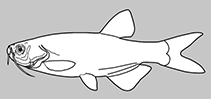
Dorsale stekels (totaal) : 0; Dorsale zachte stralen (totaal) : 11 - 12; Anale stekels: 0; Anale zachte stralen: 16 - 17; Wervels: 39 - 40. Diagnosis: Within the Congo basin, Raiamas brachyrhabdotos can be distinguished from R. batesii, R. kheeli and R. moorii by a lower number of lateral line scales, 44-46 vs. 68-70, 65-68 and 54-61 respectively; from R. longirostris by a shorter upper-jaw length, 46-52% of head length vs. 59%, and longer pre-anal length, 67.6-69.8% of standard length vs. 73.0%; from R. buchholzi and R. christyi by the absence of a large dark spot at the base of the caudal fin vs. presence, a longer dorsal-fin base, 13.3-14.7% of standard length vs. 10.1-12.0% and 10.4-11.6% respectively, and a longer anal-fin length, 18.4-22.5% of standard length vs. 15.2-17.6% and 13.8-16.5% respectively; from R. salmolucius by a shorter head, 28.5-29.5% of standard length vs. 30.2-33.6%, and a shorter pre-anal length, 67.6-69.1% of standard length vs. 69.9-72.9%; and from R. marqueti by a greater body depth, 23.6-29.8% of standard length vs. 18.8-23.3%, a convex predorsal profile vs. more or less horizontal; furthermore, it can be distinguished from R. marqueti and R. salmolucius by short and thin predorsal bars, not extending below the lateral line and usually covering 1-2 rows of lateral line scales, vs. wide and long bars, extending below the lateral line and covering more than 2 rows of the lateral line scales; from R. intermedius by a longer predorsal length, 59.9-61.7% of standard length vs. 57.2-59.2%, and deeper head, 56-60% of head length vs. 46-56% (Ref. 122357). Outside the Congo basin, Raiamas brachyrhabdotos is distinguished from all other species, except R. ansorgii, R. nigeriensis and R. senegalensis by an intermediate number of lateral line scales, 44-46 vs. 36-38 in R. levequei, 58-63 in R. scarciensis and 39-42 in R. steindachneri; from R. ansorgii by the dorsal fin inserted slightly behind the insertion of pelvic-fin origin, i.e. about two or three lateral line scales between the verticals through the anterior base of dorsal fin and the pelvic-fin insertion vs. dorsal fin inserted well behind pectoral-fin origin, i.e. by about six lateral line scales, and the fourth infraorbital extends markedly backwards when compared to the posterior border of the third infraorbital vs. slightly behind; from R. nigeriensis by a longer head, 28.5-29.5% of standard length vs. 18.6-25.0%; and from R. senegalensis by a higher number of branched dorsal-fin rays, 9 vs. 8 (Ref. 122357).
Body shape (shape guide): elongated.
Levenscyclus en paargedrag
Maturiteit | Voortplanting | Paaien | Eieren | Fecunditeit | Larven
Katemo Manda, B., J. Snoeks, A. Chocha Manda and E. Vreven, 2018. Hidden species diversity in Raiamas salmolucius (Teleostei: Cyprinidae) from the Congo basin: two new species based on morphometric evidence. Ichthyol. Explor. Freshwat. 28(4):345-363. (Ref. 122357)
Status op de Rode Lijst van het IUCN (Ref. 130435: Version 2025-2 (Global))
Gevaar voor de mens
Harmless
Gebruik door de mens
Tools
Speciale rapporten
Download XML
Internetbronnen
Schattingen op basis van modellen
Fylogenetische diversiteitsindex (Ref.
82804): PD
50 = 0.5000 [Uniqueness, from 0.5 = low to 2.0 = high].
Bayesian length-weight: a=0.00589 (0.00280 - 0.01240), b=3.00 (2.82 - 3.18), in cm total length, based on LWR estimates for this (Sub)family-body shape (Ref.
93245).
Trofisch niveau (Ref.
69278): 3.4 ±0.4 se; based on size and trophs of closest relatives
Weerstandsvermogen (Ref.
120179): Gemiddeld, minimale populatieverdubbelingstijd 1,4-4,4 jaar (Preliminary K or Fecundity.).
Kwetsbaarheid van de visserij (Ref.
59153): Low vulnerability (12 of 100).
🛈