>
Gobiiformes (Gobies) >
Gobiidae (Gobies) > Gobiinae
Etymology: Trimma: Greek, trimma, -atos = something crushed (Ref. 45335); kalum: Name from Greek word “kalos” (καλός), meaning beautiful, referring to the delicate colouration of the new species. It has been informally known as Trimma RW sp 47 or T. DFH sp 23.
Environnement : milieu / zone climatique / profondeur / gamme de distribution
Écologie
marin récifal; profondeur 40 - 73 m (Ref. 122369). Tropical
Western Pacific: Palau.
Taille / Poids / Âge
Maturité: Lm ? range ? - ? cm
Max length : 1.7 cm SL mâle / non sexé; (Ref. 122369)
Description synthétique
Clés d'identification | Morphologie | Morphométrie
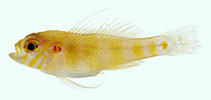
Épines dorsales (Total) : 7; Rayons mous dorsaux (Total) : 10 - 11; Épines anales: 1; Rayons mous anaux: 9 - 10. This species is distinguished by the following set of characters: no scales on cheeks, opercle and nape; second spine of the first dorsal fin elongated, reaching posteriorly to the base of the 2nd-10th ray of the second dorsal fin when adpressed; pectoral-fin rays 17-18 with 12-13 branched rays in the middle of the fin; a single dichotomous branch point in the 5th pelvic-fin ray, its length 51-75% the length of the 4th ray; total gill rakers 17-18; beneath the eye 5 papillae in row c; midline between the base of the first dorsal spine and the posterior interorbital region is a very well developed dermal crest; a U-shaped interorbital trench with no fleshy median ridge; a poorly developed postorbital trench ending between the 4th to 5th papillae in row p (which has 6 papillae in total). Colouration when alive and freshly collected is very similar in appearance to T. sheppardi, body overall yellow with three yellow bars across the cheek, and a double dark spot above the posterior portion of the opercle (Ref. 122369).
Cross section: oval.
Collected with quinaldine in a cave in a steep reef slope (Ref. 122369).
Cycle de vie et comportement reproducteur
Maturité | Reproduction | Frai | Œufs | Fécondité | Larves
Winterbottom, R., 2020. A new species of Trimma (Pisces: Gobiidae) from the northern Palauan Islands, western Pacific Ocean. Zootaxa 4808(3):582-588. (Ref. 122369)
Statut dans la liste rouge de l'IUCN (Ref. 130435: Version 2025-2 (Global))
Menace pour l'homme
Harmless
Utilisations par l'homme
Pêcheries: sans intérêt
Outils
Articles particuliers
Télécharger en XML
Sources Internet
Estimations basées sur des modèles
Indice de diversité phylogénétique (Réf.
82804): PD
50 = 0.5000 [Uniqueness, from 0.5 = low to 2.0 = high].
Bayesian length-weight: a=0.01023 (0.00477 - 0.02194), b=3.01 (2.83 - 3.19), in cm total length, based on LWR estimates for this (Sub)family-body shape (Ref.
93245).
Résilience (Réf.
120179): Haut, temps minimum de doublement de population inférieur à 15 mois (Preliminary K or Fecundity.).
Vulnérabilité de la pêche (Ref.
59153): Low vulnerability (10 of 100).
🛈