Môi trường: môi trường / vùng khí hậu / Mức độ sâu / phạm vi phân phối
Sinh thái học
biển cùng sống ở rạn san hô; mức độ sâu 2 - 40 m (Ref. 117607). Tropical
Western Indian Ocean: restricted to the Red Sea and the Gulf of Aden,
Bộ gần gũi / Khối lượng (Trọng lượng) / Tuổi
Chín muồi sinh dục: Lm ? range ? - ? cm
Max length : 35.0 cm SL con đực/không giới tính; (Ref. 117607)
Mô tả ngắn gọn
Khóa để định loại | Hình thái học | Sinh trắc học
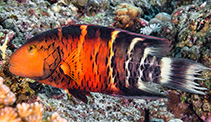
Các tia vây lưng cứng (tổng cộng) : 9; Các vây lưng mềm (tổng cộng) : 10; Tia cứng vây hậu môn: 3; Tia mềm vây hậu môn: 8. This species is distinguished by the following characters: D IX, 10; gill rakers 13-16 (usually 13 or 14); body depth 2.3-2.6 in SL; caudal-fin rays are free of membrane posteriorly in adults. Colouration: juveniles brown, usually with five white bars across the body, first bar broadest and brightest, bar on midside of abdomen when present indistinct, fifth bar anteriorly on caudal peduncle and faint; all bars except the bar on midside of abdomen extend onto dorsal and anal fins; on nape and interorbital space are three short faint bars; from eye across preopercle with a short oblique white band; base of caudal fin with a narrow white bar; anterior in dorsal fin with a large dark blue spot, surrounded with orange dorsally; subadults and females have similar white bars as juveniles but the second bar becoming distinct and nearly reaching dorsal-fin base; scales edged with black on postorbital head, dorsum, and ventrally on body; humeral area with three (rarely two) irregular, dark blue or black marks; postorbital head and anterior body are suffused with orange; caudal fin is broadly white basally, followed by a slightly broader black zone, outer fifth pale grey; males with much more black pigment on body scales and posteriorly on head, and the suffusion of orange becoming bright orange-red area on the postorbital head, anterior of body, abdomen, and pectoral-fin base, with color extending posteriorly nearly to second white bar, enclosing first bar in large males; head brown with a large orangish area anteriorly around eye, on cheek and most of snout; caudal fin same as in females (Ref. 117607).
Cross section: compressed.
Adults are usually found as solitary individuals over sand or sand-and-rubble substrata adjacent to sheltered coral reefs. The large males are usually seen swimming along the reef margin while the juveniles are more secretive and may be found at entrance of small caves or crevices, resembling and often confused with Wetmorella bifasciata. Sometimes this species accompanies goatfishes or even divers who may expose fossorial animals by their flippers. Feeds on benthic invertebrates (Ref. 117607).
Vòng đời và hành vi giao phối
Chín muồi sinh dục | Sự tái sinh sản | Đẻ trứng | Các trứng | Sự sinh sản | Ấu trùng
Bogorodsky, S.V., T.J. Alpermann and A.O. Mal, 2016. Redescription of Cheilinus quinquecinctus Rüppell, 1835 (Pisces: Perciformes, Labridae), a valid endemic Red Sea wrasse. Zootaxa 4158(4):451-472. (Ref. 117607)
Tình trạng Sách đỏ IUCN (Ref. 130435: Version 2025-2 (Global))
Mối đe dọa đối với con người
Harmless
Sử dụng của con người
Các công cụ
Báo cáo đặc biệt
Tải xuống XML
Các nguồn internet
Ước tính dựa trên mô hình
Chỉ số đa dạng phát sinh loài (Tài liệu tham khảo
82804): PD
50 = 0.7500 [Uniqueness, from 0.5 = low to 2.0 = high].
Bayesian length-weight: a=0.01585 (0.00697 - 0.03603), b=2.96 (2.77 - 3.15), in cm total length, based on LWR estimates for this (Sub)family-body shape (Ref.
93245).
Mức dinh dưỡng (Tài liệu tham khảo
69278): 3.9 ±0.4 se; based on size and trophs of closest relatives
Thích nghi nhanh (Tài liệu tham khảo
120179): Trung bình, thời gian nhân đôi của chủng quần tối thiểu là 1.4 - 4.4 năm (Preliminary K or Fecundity.).
Sự dễ bị tổn thương của nghề đánh cá (Ref.
59153): Low to moderate vulnerability (33 of 100).
🛈