Classificatie / Namen
Lokale namen | Synoniemen | Catalog of Fishes(Genus, Soort(en)) | ITIS | CoL | WoRMS | Cloffa
>
Cichliformes (Cichlids, convict blennies) >
Cichlidae (Cichlids) > Geophaginae
Etymology: Geophagus: Greek, gea = the earth + Greek, phagein = to eat (Ref. 45335); multiocellus: Name from Latin 'multum' for several and 'ocellus' for little eyes or jewels; referring to the presence of small pale blue spots with minute bright blue dots on its centre on the caudal fin.
Milieu: milieu / Klimaatzone / Diepte / verspreidingsgebied
Ecologie
; zoet water benthopelagisch. Tropical
South America: Brazil.
Grootte / Gewicht / Leeftijd
Maturiteit: Lm ? range ? - ? cm
Max length : 10.3 cm SL mannelijk / geslacht onbekend; (Ref. 119412)
Korte beschrijving
Determinatiesleutels | Morfologie | Morfometrie
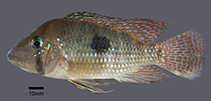
This species is distinguished from all other species of G. brasiliensis group by having small pale blue spots with minute bright blue dots on its centre, usually vertically coalesced to form short bars on the caudal fin (vs. never a similar pattern); further distinguished from G. rufomarginatus, G. obscurus, G. santosi, by the absence of an oblique iridescent blue zone between humeral region and anterior portion of dorsal-fin base (vs. present); differs from G. rufomarginatus by having dorsal-fin lappets with grey or dark brown edges (vs. red), with denticles on gill-rakers of the first branchial arch (vs. absent) and without longitudinal series of small light blue spots between anal-fin spines and rays (vs. present); differs from G. santosi by having blue bands crossing anal-fin rays (vs. blue bands parallel to fin rays); differs from G. itapicuruensis with D XIV (vs. XIII), lateral spot rounded (vs. elliptical), no horizontal dark brown band on snout (vs. presencet); differs from G. brasiliensis by having longitudinal blue bands crossing the anal-fin rays (vs. transversal blue bands crossing the anal-fin rays) and mouth subterminal (vs. subdorsal) (Ref. 119412).
Cross section: compressed.
Levenscyclus en paargedrag
Maturiteit | Voortplanting | Paaien | Eieren | Fecunditeit | Larven
Mattos, J.L. and W.J.E.M. Costa, 2018. Three new species of the 'Geophagus' brasiliensis species group from the northeast Brazil (Cichlidae, Geophagini). OrinoZoosyst. Evol. 94(2):325-337. (Ref. 119412)
Status op de Rode Lijst van het IUCN (Ref. 130435: Version 2025-2 (Global))
Gevaar voor de mens
Harmless
Gebruik door de mens
Tools
Speciale rapporten
Download XML
Internetbronnen
Schattingen op basis van modellen
Fylogenetische diversiteitsindex (Ref.
82804): PD
50 = 0.5000 [Uniqueness, from 0.5 = low to 2.0 = high].
Bayesian length-weight: a=0.02399 (0.01144 - 0.05029), b=3.01 (2.83 - 3.19), in cm total length, based on LWR estimates for this (Sub)family-body shape (Ref.
93245).
Trofisch niveau (Ref.
69278): 2.5 ±0.1 se; based on size and trophs of closest relatives
Weerstandsvermogen (Ref.
120179): Hoog, minimale populatieverdubbelingstijd minder dan 15 maanden (Preliminary K or Fecundity.).
Kwetsbaarheid van de visserij (Ref.
59153): Low vulnerability (10 of 100).
🛈