Clasificación / Nombres
Nombres comunes | Sinónimos | Catalog of Fishes(Género, Especie) | ITIS | CoL | WoRMS | Cloffa
>
Cyprinodontiformes (Rivulines, killifishes and live bearers) >
Rivulidae (Rivulines) > Rivulinae
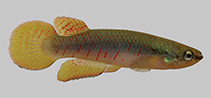
Etymology: interruptus: Name from Latin adjective meaning interrupted, referring to the presence of conspicuous oblique red bars forming chevron-like marks usually disrupted in the midline of the body in males.
Entorno: milieu / zona climática / rango de profundidad / gama de distribución
Ecología
; agua dulce bentopelágico. Tropical
South America: Brazil.
Tamaño / Peso / Edad
Madurez: Lm ? range ? - ? cm
Max length : 3.2 cm SL macho / no sexado; (Ref. 119399); 2.9 cm SL (female)
Descripción breve
Claves de identificación | Morfología | Morfometría
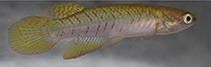
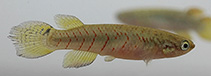
This species is distinguished from all its congeners of the M. pictus group, except M. nigromarginatus, by having an oblique chevron-like bars interrupted, mainly on the midline of the flank in males (vs. bars continuous, vestigial, irregular or presence of longitudinal rows of red dots on the side of the body; never bars interrupted on the midline of the body); differs from all other species in the M. pictus species group, except M. planaltinus, M. leali, M. pictus, by having a rounded dorsal fin (vs. slight pointed or pointed dorsal fin); differs from M. amambaiensis, M. apiamici, M. egens, M. faucireticulatus, M. ivinhemensis, M. lealiby a higher caudal-fin ray count 32-33 (vs. 28-31); differs from M. egens, M. faucireticulatus, M. leali, M. litteratus, M. rutilicaudus, M. formosensis by the position of the anal-fin origin between the pleural ribs of 15th and 16th vertebrae (vs. 13th and 15th vertebrae); differs from M. apiamici, M. egens, M. faucireticulatus, M. pictus, M. polychromus, M. proximus by the dorsal-fin origin at a vertical through the base of the 8th anal-fin ray (vs. vertical through base of 7th or 9th-10th anal-fin ray); differs from M. amambaiensis, M. egens, M. faucireticulatus, M. ivinhemensis, M. planaltinus, M. polychromus, M. nigropunctatus, M. ofaie, M. formosensis by the origin of dorsal-fin between neural spines of 18th and 19th vertebrae (vs. 19th and 22th); differs from M. egens, M. faucireticulatus, M. leali, M. litteratus, M. scalaris, M. vittatus, M. linearis, M. proximus by the tip of pelvic fin reaching the urogenital papilla in males (vs. reaching 1st to 4th anal fin ray). Also, another interesting diagnostic character is the presence of 8 rays in the pelvic fin in about 35% of the analysed specimens (vs. 5-7 rays, never 8 rays present in the pelvic fin) (Ref. 119399).
Cross section: angular.
Recorded in a typical Cerrado area, inserted into the urban area of Campo Grande town at an altitude of 594 m a.s.l.. It was found in a small first order creek, but was only captured in border areas with dense aquatic vegetation, mainly grasses. The biotope, which is locally called 'veredas', a freshwater ecosystem comprising streams bordered by the buriti-palm, typically found in the Cerrado Biome, has moderate current speed. However, the area where the species was recorded is formed by small backwaters, with a clayey substrate and with a maximum depth of 10 cm. This species is encountered in areas exposed to the sun as well as in areas shaded by trees, mainly buritis-palm (Mauritia flexuosa). The region also has a slightly undulating terrain and according to the classification of Koppen-Geiger has rainy summers and dry winters (Ref. 119399).
Ciclo vital y comportamiento de apareamiento
Madurez | Reproducción | Puesta | Huevos | Fecundidad | Larva
Volcan, M.V., F. Severo-Neto and L.E.K. Lanés, 2018. Unrecognized biodiversity in a world’s hotspot: three new species of Melanorivulus (Cyprinodontiformes: Rivulidae) from tributaries of the right bank of the Rio Paraná basin, Brazilian Cerrado. Zoosyst. Evol. 94(2):263-280. (Ref. 119399)
Situación en la Lista Roja de la UICN (Ref. 130435: Version 2025-2 (Global))
Amenaza para el ser humano
Harmless
Usos humanos
Herramientas
Informes especiales
Descargar XML
Fuentes de Internet
Estimaciones basadas en modelos
Índice de diversidad filogenética (Referencia
82804): PD
50 = 0.5000 [Uniqueness, from 0.5 = low to 2.0 = high].
Bayesian length-weight: a=0.00661 (0.00315 - 0.01385), b=3.10 (2.92 - 3.28), in cm total length, based on LWR estimates for this (Sub)family-body shape (Ref.
93245).
Nivel trófico (Referencia
69278): 3.1 ±0.4 se; based on size and trophs of closest relatives
Resiliencia (Referencia
120179): Alto, población duplicada en un tiempo mínimo inferior a 15 meses (Preliminary K or Fecundity.).
Vulnerabilidad pesquera (Ref.
59153): Low vulnerability (10 of 100).
🛈