>
Gobiiformes (Gobies) >
Gobiidae (Gobies) > Gobionellinae
Etymology: Rhinogobius: Greek, rhinos = nose + Latin, gobius = gudgeon (Ref. 45335); yonezawai: Named for Mr. Toshihiko Yonezawa.
Eponymy: Toshihiko Yonezawa is a Japanese ichthyologist who works for the Foundation of Kagoshima Environmental Research and Service. [...] (Ref. 128868), visit book page.
Entorno: milieu / zona climática / rango de profundidad / gama de distribución
Ecología
; agua dulce demersal; anfidromo (Ref. 123096). Subtropical
Asia: Japan, Ryukyu Is.
Tamaño / Peso / Edad
Madurez: Lm ? range ? - ? cm
Max length : 7.5 cm SL macho / no sexado; (Ref. 123096); 6.0 cm SL (female)
Descripción breve
Claves de identificación | Morfología | Morfometría
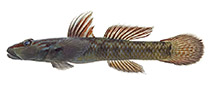
Espinas dorsales (total) : 7; Radios blandos dorsales (total) : 8; Espinas anales: 1; Radios blandos anales: 8; Vértebra: 26. This species is distinguished from its congeners by the following characters: longitudinal scales 35-39; vertebrae 10 + 16 + 26; males with first dorsal fin high and falcate, non-filamentous, the longest seond and/or third spine(s) extending posteriorly to a space between bases of first and fourth second dorsal-fin branched rays when adpressed; fifth pelvic-fin segmented ray divided into 4 branches at its first (most proximal) segmenting point; pectoral-fin base and the prepelvic areas are naked; belly with small cycloid scales except for a narrow area around ventral midline or anterior half of ventral midline; longitudinal rows of sensory-papillae on cheek with no tranverse rows. Colouration: pectoral fin base with a black oval spot; temporal region with 2 red stripes, reaching posteriorly to, or around, dorsum of body below the first dorsal fin; caudal fin of males with 6-8 vertical deep-red or reddish-orange lines, in females, a black bifurcated blotch posteriorly at the base when alive or freshly collected (Ref. 123096).
Body shape (shape guide): elongated; Cross section: oval.
A species that is amphidromous but landlocked in few freshwater reservoirs ok Okinawa-jima I. (Ref. 123096).
Ciclo vital y comportamiento de apareamiento
Madurez | Reproducción | Puesta | Huevos | Fecundidad | Larva
Suzuki, T., N. Oseko, S. Kimura and K. Shibukawa, 2020. Two new species of torrential gobies of the Genus Rhinogobius from the Ryukyu Islands, Japan. Bull. Kanagawa Prefect. Mus. (Nat. Sci.) 49:7-28. (Ref. 123096)
Situación en la Lista Roja de la UICN (Ref. 130435: Version 2025-2 (Global))
Amenaza para el ser humano
Harmless
Usos humanos
Pesquerías: sin interés
Herramientas
Informes especiales
Descargar XML
Fuentes de Internet
Estimaciones basadas en modelos
Índice de diversidad filogenética (Referencia
82804): PD
50 = 0.5000 [Uniqueness, from 0.5 = low to 2.0 = high].
Bayesian length-weight: a=0.00813 (0.00356 - 0.01856), b=3.08 (2.91 - 3.25), in cm total length, based on LWR estimates for this Genus-body shape (Ref.
93245).
Nivel trófico (Referencia
69278): 3.3 ±0.4 se; based on size and trophs of closest relatives
Resiliencia (Referencia
120179): Alto, población duplicada en un tiempo mínimo inferior a 15 meses (Preliminary K or Fecundity.).
Vulnerabilidad pesquera (Ref.
59153): Low vulnerability (10 of 100).
🛈