>
Anguilliformes (Eels and morays) >
Ophichthidae (Snake eels) > Ophichthinae
Etymology: Ophichthus: Greek, ophis = serpent + Greek, ichthys = fish (Ref. 45335); olivaceus: Name from Latin, referring to its coloration, olivaceus.
Environnement : milieu / zone climatique / profondeur / gamme de distribution
Écologie
marin bathydémersal; profondeur 35 - 63 m (Ref. 123091). Tropical
Western Indian Ocean: Red Sea, southern Saudi Arabia.
Taille / Poids / Âge
Maturité: Lm ? range ? - ? cm
Max length : 75.6 cm TL (female)
Description synthétique
Clés d'identification | Morphologie | Morphométrie
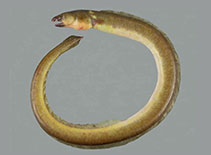
Vertèbres: 141 - 145. This speies is distinguished by the following characters: moderately elongate species, tail length 46.3-46.4%, head length 9.0-10.4%, and body depth at gill opening 3.6-4.2% of total length; dorsal-fin origin is above the middle of pectoral fin; pectoral fin rounded, elongate and well-developed; posterior nostril within upper lip, not visible externally; upper lip with two minute barbels, the first between anterior and posterior nostrils, the second beneath mid orbit; pores distinct, supraorbital pores 1 + 4, infraorbital pores 4 + 2, preopercular pores 5 + 3; teeth small, conical, uniserial on vomer and jaws; total vertebrae 141-145, mean vertebral formula 12-67.5-143. Colouration: dark tan with olivaceous hue dorsally and laterally, tan ventrally on tail and pale yellow ventrally on trunk; above pectoral-fin base are two pale yellow smudges; snout and lower jaw dark brown; throat pale orange-yellow, preopercle pale yellow and postorbital area pale yellow with numerous dark brown dots; dorsal fin and anal fins olivaceous; tip of tail dark red (Ref. 123091).
Cross section: oval.
Known from the holotype and paratype, trawled from a soft substratum from 35-63 m depth off The largest known specimen is 75.6 cm TL ripe female with packed ovaries, with ova ca. 1 mm in diameter (Ref. 123091).
Cycle de vie et comportement reproducteur
Maturité | Reproduction | Frai | Œufs | Fécondité | Larves
McCosker, J.E., S.V. Bogorodsky, A.O. Mal and T.J. Alpermann, 2020. Description of a new snake eel Ophichthus olivaceus (Teleostei: Anguilliformes, Ophichthidae) from the Red Sea. Zootaxa 4750(1):31-48. (Ref. 123091)
Statut dans la liste rouge de l'IUCN (Ref. 130435: Version 2025-2 (Global))
Menace pour l'homme
Harmless
Utilisations par l'homme
Pêcheries: sans intérêt
Outils
Articles particuliers
Télécharger en XML
Sources Internet
Estimations basées sur des modèles
Indice de diversité phylogénétique (Réf.
82804): PD
50 = 0.5000 [Uniqueness, from 0.5 = low to 2.0 = high].
Bayesian length-weight: a=0.00093 (0.00041 - 0.00214), b=2.99 (2.79 - 3.19), in cm total length, based on LWR estimates for this (Sub)family-body shape (Ref.
93245).
Niveau trophique (Réf.
69278): 4.0 ±0.7 se; based on size and trophs of closest relatives
Résilience (Réf.
120179): Milieu, temps minimum de doublement de population : 1,4 à 4,4 années (Preliminary K or Fecundity.).
Vulnérabilité de la pêche (Ref.
59153): Moderate to high vulnerability (50 of 100).
🛈