>
Stomiiformes (Lightfishes and dragonfishes) >
Stomiidae (Barbeled dragonfishes) > Melanostomiinae
Etymology: Photonectes: Greek, photos = light + Greek, nekton = swimmer (Ref. 45335); banshee: Named for the female spirit in Irish mythology meaning 'keening fairy or female' in Old Irish; referring to the series of blue luminous tissue on ventral side of the body of the specimens that resemble the tears of the keening fairy.
Entorno: milieu / zona climática / rango de profundidad / gama de distribución
Ecología
marino pelagic-oceanic; rango de profundidad ? - 100 m (Ref. 120441). Subtropical
Northwest Pacific: SW Taiwan.
Tamaño / Peso / Edad
Madurez: Lm ? range ? - ? cm
Max length : 12.5 cm SL macho / no sexado; (Ref. 120441)
Descripción breve
Claves de identificación | Morfología | Morfometría
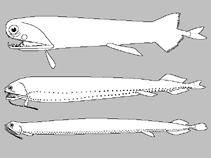
Radios blandos dorsales (total) : 19 - 20; Radios blandos anales: 22 - 23. This species is distinguished by the following set of characters: dorsal- and anal-fin rays not covered with black fleshy skin; no pectoral fins; pelvic fins inserted closer to the caudal fin than snout; IV photophores 31; and IP photophores begin halfway along the isthmus length. Within the subgenus Photonectes, it differs from its congeners by having the following characters: D 19-20; A 22-23; body slender, its maximum depth 8.6-12.0% SL; gill filaments of first branchial arch normal, not extending beyond opercular opening; barbel short, its length 35.5-54.9% HL; stem of barbel without discernible secondary light organs; barbel ends in leaf-like flap with single terminal filament; IV 31 (IP 6 + PV 25); VAV 10; AC 14; BR 9; OA 30 (OV 21 + VAL 9); no white luminous tissue on posterodorsal opercle; blue luminous tissue in short vertical streak between PV photophores, not forming longitudinal stripe; longitudinal series of blue luminous tissue in short bars from sides of isthmus to below 7th OV photophore; blue luminous tissue also present under lower jaw, and in area posterior to gill-opening; no blue luminous tissue above end of maxillary (Ref. 120441).
Cross section: compressed.
Specimens were collected in the upper 100 m by a mid-water trawl targeting the Sakura-shrimp Lucensosergia lucens (Ref. 120441).
Ciclo vital y comportamiento de apareamiento
Madurez | Reproducción | Puesta | Huevos | Fecundidad | Larva
Koeda, K. and H.-C. Ho, 2019. Photonectes banshee, a new species of the subgenus Photonectes (Stomiiformes: Stomiidae: Melanostomiinae) from Taiwan. Zootaxa 4586(1):180-186. (Ref. 120441)
Situación en la Lista Roja de la UICN (Ref. 130435: Version 2025-2 (Global))
Amenaza para el ser humano
Harmless
Usos humanos
Herramientas
Informes especiales
Descargar XML
Fuentes de Internet
Estimaciones basadas en modelos
Índice de diversidad filogenética (Referencia
82804): PD
50 = 0.5000 [Uniqueness, from 0.5 = low to 2.0 = high].
Bayesian length-weight: a=0.00302 (0.00115 - 0.00790), b=3.11 (2.88 - 3.34), in cm total length, based on LWR estimates for this (Sub)family-body shape (Ref.
93245).
Nivel trófico (Referencia
69278): 3.8 ±0.7 se; based on size and trophs of closest relatives
Resiliencia (Referencia
120179): Alto, población duplicada en un tiempo mínimo inferior a 15 meses (Preliminary K or Fecundity.).
Vulnerabilidad pesquera (Ref.
59153): Low vulnerability (10 of 100).
🛈