>
Perciformes/Serranoidei (Groupers) >
Serranidae (Sea basses: groupers and fairy basslets)
Etymology: Chelidoperca: Greek, chelidon, -onos = swift, as black as a swift + Greek, perke = perch (Ref. 45335); cerasina: Name from 'cerasina' meaning 'cherry', referring to the entirely pinkish body in relatively small fresh specimens and the characteristic reddish spots on the pectoral- and caudal-fn bases.
Milieu: milieu / Klimaatzone / Diepte / verspreidingsgebied
Ecologie
marien bathydemersaal; diepte 245 - 338 m (Ref. 123211). Tropical
Southwest Pacific: Giford Guyot Seamount (east of Australia) and New Caledonia.
Grootte / Gewicht / Leeftijd
Maturiteit: Lm ? range ? - ? cm
Max length : 14.8 cm SL mannelijk / geslacht onbekend; (Ref. 123211)
Korte beschrijving
Determinatiesleutels | Morfologie | Morfometrie
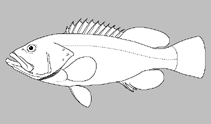
Dorsale stekels (totaal) : 10; Dorsale zachte stralen (totaal) : 10; Anale stekels: 3; Anale zachte stralen: 6. This species is distinguished from its congeners by the following set of characters: pectoral-fin rays 14-15 (modally 15); pored lateral-line scales 43-45 (44); scale rows in longitudinal series 43-46 (45); scale rows above lateral line 4 and between lateral line and base of 6th dorsal-fin spine 4; cheek scale rows 8-9 (8); posttemporal serrae 1-3 (2); preopercular serrae 14-39 (26); interopercular serrae 4-11 (8); subopercular serrae 6-17 (12); interorbital scales reaching the mid-orbit level but not extending beyond anterior margin of orbit; scales on ventral surface of lower jaw restricted to angular, none on dentary; tip of caudal fin upper lobe elongated and slightly longer than lower lobe in specimens >ca. 10.0 cm; relatively long dorsal-fin spines, length of first spine 5.6-7.4 (mean 6.7)% of SL, second 8.6-10.9 (10.1)% of SL;
anal-fin spines and soft rays relatively short, length of first spine 3.7-5.3 (4.6)% of SL, second 5.5-6.9 (6.3)% of SL, penultimate soft ray 13.7-16.4 (14.9)% of SL, longest soft ray 13.9-16.4 (15.1)% of SL; caudal-fin length 22.9-32.9 (28.3)% of SL; relatively broad inter-opercular spine, its width 5.2-6.6 (5.8)% of SL; pelvic fin short, the tip not reaching anus when adpressed; antrorse canine teeth in upper jaw, an outer row of enlarged dorsally directed canines in lower jaw. Colouration: side of body without black bands nor blotches; an orange spot on pectoral- and caudal-fin bases (Ref. 123211).
Cross section: compressed.
Levenscyclus en paargedrag
Maturiteit | Voortplanting | Paaien | Eieren | Fecunditeit | Larven
Ogino, A., S.H. Lee, W.J. Chen and M. Matsunuma, 2019. Chelidoperca cerasina sp. nov., a new perchlet (Perciformes: Serranidae) from the southwest Pacific Ocean. Ichthyol. Res. 67(1):117-132. (Ref. 123211)
Status op de Rode Lijst van het IUCN (Ref. 130435: Version 2025-2 (Global))
Gevaar voor de mens
Harmless
Gebruik door de mens
Tools
Speciale rapporten
Download XML
Internetbronnen
Schattingen op basis van modellen
Fylogenetische diversiteitsindex (Ref.
82804): PD
50 = 0.5000 [Uniqueness, from 0.5 = low to 2.0 = high].
Bayesian length-weight: a=0.01072 (0.00511 - 0.02246), b=3.06 (2.88 - 3.24), in cm total length, based on LWR estimates for this (Sub)family-body shape (Ref.
93245).
Trofisch niveau (Ref.
69278): 3.7 ±0.5 se; based on size and trophs of closest relatives
Weerstandsvermogen (Ref.
120179): Gemiddeld, minimale populatieverdubbelingstijd 1,4-4,4 jaar (Preliminary K or Fecundity.).
Kwetsbaarheid van de visserij (Ref.
59153): Low vulnerability (10 of 100).
🛈