Klassifizierung / Names
Namen | Synonyme | Catalog of Fishes(Gattung, Arten) | ITIS | CoL | WoRMS | Cloffa
>
Cichliformes (Cichlids, convict blennies) >
Cichlidae (Cichlids) > Pseudocrenilabrinae
Etymology: Otopharynx: Greek, ous = hear + Greek, pharyngx = pharynx (Ref. 45335); aletes: From the Greek masculine nominative singular noun άλέτης (alétes), a grinder; the name alludes to the well-defined group of conspicuously enlarged molariform teeth on the lower pharyngeal bone; a noun in apposition (Ref. 119408).
Umwelt: Milieu / Klimazone / Tiefenbereich / Verbreitungsgebiet
Ökologie
; süßwasser benthopelagisch. Tropical
Africa: Lake Malawi off Bua Point in Malawi (Ref. 119408), possibly also Senga Bay (Ref. 119408).
Größe / Gewicht / Alter
Geschlechtsreife: Lm ? range ? - ? cm
Max length : 10.7 cm SL Männchen/unbestimmt; (Ref. 119408)
Kurzbeschreibung
Bestimmungsschlüssel | Morphologie | Morphometrie
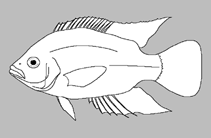
Rückenflossenstacheln (insgesamt) : 16; Rückenflossenweichstrahlen (insgesamt) : 11 - 12; Afterflossenstacheln: 3; Afterflossenweichstrahlen: 8 - 9. Diagnosis: A smallish laterally spotted haplochromine distinguished by the following characters in combination: suprapectoral spot mostly below upper lateral line but extending above it by about one-half to one scale; 10-11 gill rakers on lower outer arch; and lower pharyngeal bone with posteromedian teeth molariform with stout shafts and rounded crowns (Ref. 119408). The placement of the suprapectoral spot overlapping the upper lateral line distinguishes Otopharynx aletes from O. brooksi, O. lithobates, and O. ovatus, al of which have the suprapectoral spot entirely below and usually separated from the upper lateral line; Otopharynx aletes has more scales in the lateral line, 34-36, than 31-33 in O. brooksi, 31-33 in O. spelaeotes, 29-31 in O. antron, 30-32 in O. tetraspilus, and 30-33 in O. tetrastigma, but fewer than O. decorus, which has 36-38 and which also has 13-14 soft dorsal rays vs. 11-12 in O. aletes; with 10-11 gill rakers on the lower outer arch, O. aletes is readily separated from O. auromarginatus with 14-18; its longer caudal peduncle, 1.6-2.0 times as long as deep, and shallowly emarginate caudal fin distinguish O. aletes from O. selenurus, with caudal peduncle 1.0-1.5 times as long as deep, caudal fin crescentically emarginate; the bicuspid outer jaw teeth, molariform pharyngeal teeth, and seven to eight subdorsal bars differentiate O. aletes from O. speciosus, with outer jaw teeth unicuspid, pharyngeal teeth all small, bicuspid; about four subdorsal bars; the presence of seven to eight vertical bars below dorsal-fin base separates O. aletes from O. argyrosoma, which lacks vertical bars; the unthickened, nonlobate lips differentiate O. aletes from O. pachycheilus, which has lips thickened, medially lobate; the 16 dorsal-fin spines, absence of distinct equidistant dorsal midline spots, and offshore habitat on sand or soft bottom distinguish O. aletes from O. heterodon, which has 17-18 dorsal-fin spines, about five distinct dorsal midline spots, and inhabits rocky shores (Ref. 119408). Trematocranus brevirostris somewhat resembles O. aletes, but in O. aletes the suprapectoral spot is largely below the upper lateral line but extends above it by about one-half to one scale vs. placed more above than below the upper lateral line, at least in the lectotype; the cephalic lateral-line system is not enlarged vs. pores and canals inflated; the dorsal fin has 11-12 segmented rays vs. 9; there are 54-67 outer upper-jaw teeth vs. about 43; the posteromedian teeth on the lower pharyngeal bone are molariform with stout shafts and rounded crowns vs. slightly enlarged but cuspidate; and the caudal peduncle length/depth ratio is 1.6-2.0 vs. 1.2-1.4 (Ref. 119408). Compared to Otopharynx panniculus, O. aletes has more scales in the lateral line, 34-36 vs. 31-33; and a heavier lower pharyngeal jaw bone and dentition, including enlarged, molarized teeth posteromedially vs. small, laterally compressed, bicuspid teeth; posterior horns thickened vs. slender; and anterior blade shorter, deeper vs. longer, more shallow (Ref. 119408). Compared to O. peridodeka, O. aletes has the hemijaws in ventral view divergent caudally and distant from each other vs. approximated, convergent; and a heavier lower pharyngeal bone, with horns thicker, posteromedian teeth enlarged, and molarized with nearly hemispherical crowns vs. more lightly built, horns narrower, posteromedian teeth somewhat enlarged but more laterally compressed, cuspidate (Ref. 119408).
Body shape (shape guide): short and / or deep.
Lebenszyklus und Paarungsverhalten
Geschlechtsreife | Fortpflanzung | Ablaichen | Eier | Fruchtbarkeit | Larven
Oliver, M.K., 2018. Six new species of the Cichlid genus Otopharynx from Lake Malaŵi (Teleostei: Cichlidae). Bulletin of the Peabody Museum of Natural History 59(2):159-197. (Ref. 119408)
IUCN Rote Liste Status (Ref. 130435: Version 2025-2 (Global))
Bedrohung für Menschen
Harmless
Nutzung durch Menschen
Tools
Zusatzinformationen
Download XML
Internet Quellen
Schätzungen auf der Grundlage von Modellen
Phylogenetischer Diversitätsindex (Ref.
82804): PD
50 = 0.5000 [Uniqueness, from 0.5 = low to 2.0 = high].
Bayesian length-weight: a=0.00389 (0.00180 - 0.00842), b=3.12 (2.94 - 3.30), in cm total length, based on all LWR estimates for this body shape (Ref.
93245).
Trophische Ebene (Ref.
69278): 3.4 ±0.4 se; based on size and trophs of closest relatives
Widerstandsfähigkeit (Ref.
120179): hoch, Verdopplung der Population dauert weniger als 15 Monate. (Preliminary K or Fecundity.).
Anfälligkeit der Fischerei (Ref.
59153): Low vulnerability (10 of 100).
🛈