Classificação / Nomes
Nomes comuns | Sinônimos | Catalog of Fishes(Gênero, Espécies) | ITIS | CoL | WoRMS | Cloffa
>
Cichliformes (Cichlids, convict blennies) >
Cichlidae (Cichlids) > Pseudocrenilabrinae
Etymology: Otopharynx: Greek, ous = hear + Greek, pharyngx = pharynx (Ref. 45335); panniculus: From the Latin noun panniculus, a small cloth patch, with reference to the appearance of the quadrate suprapectoral spot neatly 'stitched' between two vertical bars; a noun in apposition (Ref. 119408).
Meio ambiente: milieu / Zona climática / intervalo de profundidade / faixa de distribuição
Ecologia
; Água doce bentopelágico. Tropical
Africa: Lake Malawi in Malawi (Ref. 119408).
Tamanho / Peso / Idade
Maturidade: Lm ? range ? - ? cm
Max length : 7.3 cm SL macho/indeterminado; (Ref. 119408)
Descrição suscinta
Chaves de identificação | Morfologia | Morfometria
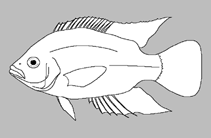
Espinhos dorsais (total) : 15 - 16; Raios dorsais (total) : 9 - 11; Espinhos anais: 3; Raios anais : 8 - 9; Vértebras: 32. Diagnosis: A small, laterally spotted haplochromine which is recognized by the following combination of characters: prominent, quadrate suprapectoral spot spanning subdorsal vertical bars 3-4, this spot below and touching the upper lateral line and usually extending slightly above it; 13-15 lower-limb gill rakers; and deep body, depth 34.4-38.2% of standard length (Ref. 119408). The shape and placement of the suprapectoral spot distinguish Otopharynx panniculus from O. brooksi, O. lithobates, and O. ovatus, in all of which this spot lies entirely below and usually separated from the upper lateral line; its shorter lateral line of 31-33 scales discriminates O. panniculus from O. decorus with 36-38 scales, O. argyrosoma with 34-36 scales, and O. selenurus with 34-35 scales; its higher gill raker count of 13-15 on lower limb distinguishes O. panniculus from O. tetrastigma with 9-11, O. speciosus with 11-12, and O. antron with 10-11; its shorter head, 31.9-33.7% of standard length, and longer caudal peduncle, 18.8-21.7% of standard length, distinguish O. panniculus from O. spelaeotes, with head 34.8-36.6% of standard length and caudal peduncle length 13.2-15.6% of standard length; its 15-16 dorsal-fin spines and lack of dorsal midline spots separate O. panniculus from O. heterodon, which has 17-18 dorsal spines and five or six distinct, small, dark dorsal midline spots just below the dorsal-fin base; the presence of several slightly enlarged teeth in the median columns of the lower pharyngeal bone separates O. panniculus from O. auromarginatus and O. tetraspilus, which have only small, compressed, bicuspid pharyngeal teeth; in O. panniculus the lips are thin and lack median lobes, distinguishing it from O. pachycheilus with lips hypertrophied, with prominent median lobes (Ref. 119408). Compared to O. aletes, O. panniculus has fewer lateral-line scales, 31-33 vs. 34-36; and a lighter lower pharyngeal jaw and dentition, with small, laterally compressed, bicuspid posteromedian pharyngeal teeth vs. these teeth enlarged, molarized; slender posterior horns vs. horns thickened; and anterior blade longer, shallower vs. blade shorter, deeper (Ref. 119408). Compared to O. peridodeka, O. panniculus has fewer lateral-line scales, 31-33 vs. 34-35; usually has more lower-limb gill rakers, 13-15 vs. 11-13; and lower pharyngeal teeth more uniform in size, those of the median columns scarcely larger than the more lateral teeth vs. posterior teeth of median columns distinctly enlarged relative to lateral teeth (Ref. 119408). Otopharynx panniculus superficially resembles Trematocranus "brevirostris deep", but that still-undescribed species is from substantially deeper water, 90-102 m vs. about 42 m; the suprapectoral spot apparently spans subdorsal bars 2-3 vs. bars 3-4 in O. panniculus; and there are 10-13 lower-limb gill rakers vs. 13-15 (Ref. 119408). Trematocranus brevirostris itself is also similar, but in O. panniculus the suprapectoral spot is roughly square, covers four to five longitudinal scales, and is located almost entirely below the upper lateral line vs. taller than long, covers three scales,and at least in the lectotype is placed more above than below the upper lateral line; the cephalic lateral-line system is not enlarged vs. pores and canals of the preorbital, nasal, dentary, and lacrimal bones inflated; there are 52-66 outer upper-jaw teeth vs. about 43; and 3-4 cheek scale rows vs. 2 (Ref. 119408).
Body shape (shape guide): short and / or deep.
Ciclo de vida ou comportamento de acasalamento
Maturidade | Reprodução | Desova | Ovos | Fecundidade | Larvas
Oliver, M.K., 2018. Six new species of the Cichlid genus Otopharynx from Lake Malaŵi (Teleostei: Cichlidae). Bulletin of the Peabody Museum of Natural History 59(2):159-197. (Ref. 119408)
Status na Lista Vermelha da UICN (Ref. 130435: Version 2025-2 (Global))
Ameaça para os humanos
Harmless
Uso pelos humanos
Ferramentas
Relatórios especiais
Baixar XML
Fontes da internet
Estimativas baseadas em modelos
Índice de diversidade filogenética (Ref.
82804): PD
50 = 0.5000 [Uniqueness, from 0.5 = low to 2.0 = high].
Bayesian length-weight: a=0.00389 (0.00180 - 0.00842), b=3.12 (2.94 - 3.30), in cm total length, based on all LWR estimates for this body shape (Ref.
93245).
Nível Trófico (Ref.
69278): 3.3 ±0.4 se; based on size and trophs of closest relatives
Resiliência (Ref.
120179): Elevada, tempo mínimo de duplicação da população menor que 15 meses (Preliminary K or Fecundity.).
Vulnerabilidade da pesca (Ref.
59153): Low vulnerability (10 of 100).
🛈