Clasificación / Nombres
Nombres comunes | Sinónimos | Catalog of Fishes(Género, Especie) | ITIS | CoL | WoRMS | Cloffa
>
Cyprinodontiformes (Rivulines, killifishes and live bearers) >
Nothobranchiidae (African rivulines)
Etymology: Nothobranchius: Greek, nothos = false + Greek, brangchia = gill (Ref. 45335); albertinensis: The specific name, albertinensis, is given in reference to the Albertine Rift, in which valley the species is found in the northern Lake Albert basin and extending into the Albert Nile drainage; an adjective derived from the geographical name (Ref. 123150).
Entorno: milieu / zona climática / rango de profundidad / gama de distribución
Ecología
; agua dulce bentopelágico; pH range: 7.8 - 8.5. Tropical; 29°C - 34°C (Ref. 123150)
Africa: ephemeral pools and marshes of Albert Nile drainage and small river systems into north-eastern part of Lake Albert in northwestern Uganda (Ref. 123150).
Tamaño / Peso / Edad
Madurez: Lm ? range ? - ? cm
Max length : 5.0 cm SL macho / no sexado; (Ref. 123150)
Descripción breve
Claves de identificación | Morfología | Morfometría
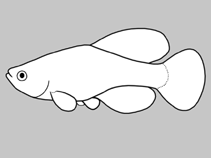
Espinas dorsales (total) : 0; Radios blandos dorsales (total) : 15 - 18; Espinas anales: 0; Radios blandos anales: 16 - 18. Diagnosis: Nothobranchius albertinensis is distinguished from all other species of the genus, with the exception of N. ugandensis, by the following combination of characters in males: body colouration light blue with red-brown scale margins; frontal part of head and snout red-brown and throat light blue; caudal fin uniform red (Ref. 123150). Furthermore, it differs from N. ugandensis by a yellow dorsal fin with red-brown stripes in medial part parallel to fin rays vs. light blue with red-brown spots and irregular stripes perpendicular to fin rays; yellow anal fin without markings vs. light blue and occasionally with red-brown spots; anal fin positioned anterior to dorsal fin, mean preanal length 59.8% of standard length and mean predorsal length 60.7% of standard length vs. posteriorly positioned with 60.9% of standard length and 60.2% respectively in N. ugandensis; and greater anal-fin base length, 22.5-25.9% of standard length vs. 19.3-22.2% (Ref. 123150).
Body shape (shape guide): fusiform / normal; Cross section: compressed.
Found in ephemeral pools and marshes as well as small river systems (Ref. 123150); the type locality is an isolated pool, about 1 m at the deepest point, in an area that was overgrown by reeds (Ref. 123150).
Ciclo vital y comportamiento de apareamiento
Madurez | Reproducción | Puesta | Huevos | Fecundidad | Larva
Nagy, B., B.R. Watters, P.D.W. van der Merwe, F.P.D. Cotterill and D.U. Bellstedt, 2020. Review of the Nothobranchius ugandensis species group from the inland plateau of eastern Africa with descriptions of six new species (Teleostei: Nothobranchiidae). Ichthyol. Explor. Freshwat. 30(1):21-73. (Ref. 123150)
Situación en la Lista Roja de la UICN (Ref. 130435: Version 2025-2 (Global))
Amenaza para el ser humano
Harmless
Usos humanos
Pesquerías: sin interés
Herramientas
Informes especiales
Descargar XML
Fuentes de Internet
Estimaciones basadas en modelos
Índice de diversidad filogenética (Referencia
82804): PD
50 = 0.5000 [Uniqueness, from 0.5 = low to 2.0 = high].
Bayesian length-weight: a=0.00603 (0.00250 - 0.01453), b=3.13 (2.93 - 3.33), in cm total length, based on LWR estimates for this (Sub)family-body shape (Ref.
93245).
Nivel trófico (Referencia
69278): 3.2 ±0.4 se; based on size and trophs of closest relatives
Vulnerabilidad pesquera (Ref.
59153): Low vulnerability (10 of 100).
🛈