Klassifizierung / Names
Namen | Synonyme | Catalog of Fishes(Gattung, Arten) | ITIS | CoL | WoRMS | Cloffa
>
Lophiiformes (Anglerfishes) >
Oneirodidae (Dreamers)
Etymology: Oneirodes: Greek, 'oneiros' = a dream or dreamlike or out of a dream (suggesting this fish is so strange and marvelous that can exist only in dreams) (Ref. 86949); cordifer: Name meaning 'heart bearing' for the characteristic shape of the suboperculum.
Umwelt: Milieu / Klimazone / Tiefenbereich / Verbreitungsgebiet
Ökologie
seewasser demersal; tiefenbereich ? - 1000 m (Ref. 123293). Tropical
Northwest: Pacific Japan.
Größe / Gewicht / Alter
Geschlechtsreife: Lm ? range ? - ? cm
Max length : 2.5 cm SL Männchen/unbestimmt; (Ref. 123293)
Kurzbeschreibung
Bestimmungsschlüssel | Morphologie | Morphometrie
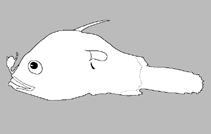
Rückenflossenweichstrahlen (insgesamt) : 5; Afterflossenweichstrahlen: 4; Wirbelzahl: 18. This species is distinguished by the following set of characters: D 5; A 4; P 15; esca with a single large, highly elongated (2.5 times greater than height of bulb) anterior process devoid of appendages but multiply branching at the top (length of branches approximately 1/9 of total length of entire appendage), it is completely pigmented in basal half of its length and containing a pigmented inner core in distal part; the core occupies approximately 2/3 of length of distal half of appendage and ends with multiple pigmented specks (without 'eyespot'); sides of base of anterior process bear a pair of short (commensurate with height of terminal papillae), fan shaped, multiply branching anterolateral processes; the central process is very short, comblike, with long base, branching directly from the base; posterior process moderately long, somewhat longer than height of bulb, pinnately branched (filaments arranged more or less oppositely), unpigmented; the terminal papilla high (approximately one third of height of bulb) and conical; bulb with internal pigmentation and dorsal pigmented mark, the latter contains a paired round transparent 'eyespot' (Ref. 123293).
Cross section: compressed.
Lebenszyklus und Paarungsverhalten
Geschlechtsreife | Fortpflanzung | Ablaichen | Eier | Fruchtbarkeit | Larven
Prokofiev, A.M., 2014. New and rare species of deepsea pelagic fishes of families Opisthoproctidae, Melanostomiidae, Oneirodidae, and Linophrynidae. J. Ichthyol. 54(6):377-383. (Ref. 123293)
IUCN Rote Liste Status (Ref. 130435: Version 2025-2 (Global))
Bedrohung für Menschen
Harmless
Nutzung durch Menschen
Tools
Zusatzinformationen
Download XML
Internet Quellen
Schätzungen auf der Grundlage von Modellen
Phylogenetischer Diversitätsindex (Ref.
82804): PD
50 = 0.5000 [Uniqueness, from 0.5 = low to 2.0 = high].
Bayesian length-weight: a=0.00389 (0.00180 - 0.00842), b=3.12 (2.94 - 3.30), in cm total length, based on all LWR estimates for this body shape (Ref.
93245).
Trophische Ebene (Ref.
69278): 3.2 ±0.6 se; based on size and trophs of closest relatives
Widerstandsfähigkeit (Ref.
120179): hoch, Verdopplung der Population dauert weniger als 15 Monate. (Preliminary K or Fecundity.).
Anfälligkeit der Fischerei (Ref.
59153): Low vulnerability (10 of 100).
🛈