Classification / Noms
Noms communs | Synonymes | Catalog of Fishes(Genre, Espèce) | ITIS | CoL | WoRMS | Cloffa
>
Cichliformes (Cichlids, convict blennies) >
Cichlidae (Cichlids) > Geophaginae
Etymology: Gymnogeophagus: Greek, gymnos = naked + Greek, gea = the earth + Greek, phaegein, to eat (Ref. 45335); lipokarenos: Name from Greek 'lipos' meaning fat, and from 'kara' for head, referring to the extremely large adipose hump of adult males; noun in apposition.
Environnement : milieu / zone climatique / profondeur / gamme de distribution
Écologie
; eau douce benthopélagique. Tropical
South America: Brazil.
Taille / Poids / Âge
Maturité: Lm ? range ? - ? cm
Max length : 12.3 cm SL mâle / non sexé; (Ref. 118066)
Description synthétique
Clés d'identification | Morphologie | Morphométrie
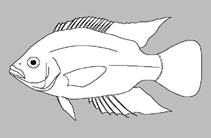
Épines dorsales (Total) : 13 - 14; Rayons mous dorsaux (Total) : 9 - 11; Épines anales: 3; Rayons mous anaux: 7 - 9; Vertèbres: 28. This species is distinguished from all congeners by the following characters: bright yellow color pattern of the unpaired fins (vs. mostly red in other species); covered with white dots aligned between rays; distal border of the dorsal fin and dorsal and ventral contours of caudal fin red with thin light stripes; prominent adipose hump in mature males, extending dorsally above the tip of the longest dorsal-fin spines (vs. less developed) (Ref. 118066).
Cross section: compressed.
Cycle de vie et comportement reproducteur
Maturité | Reproduction | Frai | Œufs | Fécondité | Larves
Malabarba, L.R., M.C. Malabarba and R.E. Reis, 2015. Descriptions of five new species of the Neotropical cichlid genus Gymnogeophagus Miranda Ribeiro, 1918 (Teleostei: Cichliformes) from the rio Uruguay drainage. Neotrop. Ichthyol. 13(4):637-662. (Ref. 118066)
Statut dans la liste rouge de l'IUCN (Ref. 130435: Version 2025-2 (Global))
Menace pour l'homme
Harmless
Utilisations par l'homme
Outils
Articles particuliers
Télécharger en XML
Sources Internet
Estimations basées sur des modèles
Indice de diversité phylogénétique (Réf.
82804): PD
50 = 0.5000 [Uniqueness, from 0.5 = low to 2.0 = high].
Bayesian length-weight: a=0.01995 (0.00918 - 0.04336), b=3.01 (2.83 - 3.19), in cm total length, based on LWR estimates for this (Sub)family-body shape (Ref.
93245).
Niveau trophique (Réf.
69278): 3.3 ±0.5 se; based on size and trophs of closest relatives
Résilience (Réf.
120179): Haut, temps minimum de doublement de population inférieur à 15 mois (Preliminary K or Fecundity.).
Vulnérabilité de la pêche (Ref.
59153): Low vulnerability (10 of 100).
🛈