分類 / 名稱
俗名 | 同種異名 | Catalog of Fishes(屬, 種) | ITIS | CoL | WoRMS | Cloffa
Teleostei >
Cichliformes (Cichlids, convict blennies)
鱸形目 (Cichlids, convict blennies) >
Cichlidae (Cichlids)
慈鯛科魚類 (Cichlids) > Geophaginae
Etymology: Gymnogeophagus: Greek, gymnos = naked + Greek, gea = the earth + Greek, phaegein, to eat (Ref. 45335); jaryi: Name derived from the Guaraní word 'jarýi' meaning grandmother, and it is dedicated to the Non-Governmental Organization of 'Abuelas de Plaza de Mayo' whose objective is to locate and restore to their legitimate families all the children who disappeared during the last Argentine dictatorship; noun in apposition.
Taxonomic Remarks
Entered from e-publication.
環境: 環境 / 氣候帶 / 深度上下限 / 配送範圍
生態學
; 淡水 底中水層性.
分布
領土 | FAO區域 | 生態系 | 發現紀錄 | 分布圖 | 簡介 | Faunafri
South America: Argentina and Paraguay.
大小 / 重量 / 年齡
成熟度: Lm ? range ? - ? cm
Max length : 13.3 cm SL 雄魚/尚未辨別雌雄; (Ref. 119666)
簡短描述
檢索表 | 型態特徵 | 形態測量圖
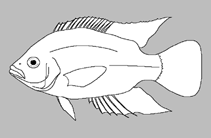
背棘 (總數) : 13 - 14; 背的軟條 (總數) : 10 - 11; 臀棘: 3; 臀鰭軟條: 8 - 9. This species is distinguished from all its congeners except G. australis and G. caaguazuensis, by the presence of a hyaline to grey anterior portion of the dorsal fin; differs from caaguazuensis by having a longer caudal peduncle, caudal fin not lyrate, central portion of scales on dorsal part of trunk light iridescent blue and white spots in soft portion of dorsal fin in adult males; differs from australis by the light iridescent blue coloration of central area of scales on the dorsal portion of trunk and tail, and by the absence of scales on the soft portion of the dorsal fin. It is further distinguished by the following unique set of characters: D 10-11 branched rays; 27-30 E1 scales; absence of lips thickening; adult males with a hump, with large white spots forming transversal stripes distally and in anterior area of the dorsal fin’s soft portion, absence of a conspicuous and oblique dark band from the eye to the anterior border of the head, anterior part of dorsal fin hyaline to grey, scales of the midlateral spot each bearing a semicircular light blue blotch, the head hump start at the horizontal through the eyes, concave anterior profile in lateral view, base of unpaired fins yellow, and whitish hyaline spots on caudal fin (Ref. 119666).
Cross section: compressed.
Inhabits streams with sandy and rocky bottom and abundant marginal vegetation. The climate where it is found, on the mountain ridge in Aristóbulo del Valle, is classified as warm and temperate. In this area there is a significant rainfall throughout the year (average per year is 1,678 mm), and even in August with the lowest precipitation, it still has a considerable amount of rain (111 mm). The lowest precipitation occur from July to September, the driest period and lowest water levels from December to February due to the marked seasonal change in temperature, and peaks in precipitation occur from May and October. The annual average temperature is 19.1°C, with 23.9ºC monthly average temperature in January and 14.3ºC in June. Water level in the stream can have important changes: water turbidity is variable among the year with peaks of turbidity after rains and increases in water visibility the rest of the year. Specimens are frequently collected in the rocky areas or associated with marsh and marginal vegetation. The holotype was collected together with the female paratype under the marginal vegetation and with fry on November 2016 (Ref. 119666).
生命週期和交配行為
成熟度 | 繁殖 | 產卵場 | 卵 | 孕卵數 | 仔魚
Alonso, F., G.E. Terán, G. Aguilera, O. Rican, J. Casciotta, W.S. Serra, A. Almirón, M.F. Benítez, I. García and J.M. Mirande, 2019. Description of a new species of the Neotropical cichlid genus Gymnogeophagus Miranda Ribeiro, 1918 (Teleostei: Cichliformes) from the Middle Parana´ basin, Misiones, Argentina. PLoS ONE 14(2):e0210166. (Ref. 119666)
IUCN 瀕危狀態 (Ref. 130435: Version 2025-2 (Global))
瀕危 (EN) (B1ab(iii)); Date assessed: 16 December 2020
人類使用
漁業: 沒有興趣
工具
特別的報告
下載 XML
網路資源
基於模型的估計
系統發育多樣性指數 (參考文獻
82804): PD
50 = 0.5000 [Uniqueness, from 0.5 = low to 2.0 = high].
Bayesian length-weight: a=0.01995 (0.00918 - 0.04336), b=3.01 (2.83 - 3.19), in cm total length, based on LWR estimates for this (Sub)family-body shape (Ref.
93245).
營養階層 (參考文獻
69278): 3.4 ±0.5 se; based on size and trophs of closest relatives
回復力 (參考文獻
120179): 高度, 族群倍增時間少於 15個月 (Preliminary K or Fecundity.).
釣魚的脆弱性 (Ref.
59153): Low vulnerability (10 of 100).
🛈