Klassifizierung / Names
Namen | Synonyme | Catalog of Fishes(Gattung, Arten) | ITIS | CoL | WoRMS | Cloffa
>
Cichliformes (Cichlids, convict blennies) >
Cichlidae (Cichlids) > Geophaginae
Etymology: Gymnogeophagus: Greek, gymnos = naked + Greek, gea = the earth + Greek, phaegein, to eat (Ref. 45335); terrapurpura: Named for the novel of G. E. Hudson 'La Tierra Purpúrea' (as it is known in the Spanish translation), in which the main character makes a trip through the same region where the new species occurs; noun in apposition.
Umwelt: Milieu / Klimazone / Tiefenbereich / Verbreitungsgebiet
Ökologie
; süßwasser benthopelagisch. Tropical
South America: Uruguay.
Größe / Gewicht / Alter
Geschlechtsreife: Lm ? range ? - ? cm
Max length : 9.2 cm SL Männchen/unbestimmt; (Ref. )
Kurzbeschreibung
Bestimmungsschlüssel | Morphologie | Morphometrie
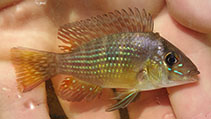
Rückenflossenstacheln (insgesamt) : 14 - 15; Rückenflossenweichstrahlen (insgesamt) : 8 - 9; Afterflossenstacheln: 3; Afterflossenweichstrahlen: 7 - 9. This species is distinguished from its congeners except for G. rhabdotus, G. meridionalis, G. setequedas, G. che by the number of E1 scales, 23-25 (vs. 26-30), and its substrate-brooding behavior. This species differs from the four species by the unique pigmentation of the dorsal fin: it differs from meridionalis in having diagonal bright blue stripes (light brown in preserved specimens) over a red background (brown in preserved specimens) in the spiny section, and a combination of round, elliptical, and elongated bright blue spots (light brown in preserved specimens) in the soft section versus whitish light blue round spots (white to light brown in preserved specimens) over a red background (brown in preserved specimens) in the whole fin of meridionalis or diagonal whitish light blue stripes (white to light brown in preserved specimens) over a red background in the whole spiny section of the fin and the distal ¾ of the soft section in rhabdotus, setequedas and che; further distinguished from rhabdotus by the termination of the bright blue band that runs above the upper lateral line before reaching a bright blue spot placed above the first perforated scale (vs. band continuous with that spot); differs further from meridionalis, setequedas and che by the anal fin pigmentation pattern which consists of light blue rounded spots (light brown in preserved specimens) over a red to orange background (brown in preserved specimens) versus white irregularly shaped spots over a dark red back ground in meridionalis or diagonal light stripes in setequedas and che; differs from meridionalis by the absence of small clear spots between anal fin rays that reach the distal edge of the fin vs. presence (Ref, 123556).
Cross section: compressed.
This species is found in a large variety of habitats including shallow lakes, floodplain lakes, rivers, and streams, mainly associated with cobble, sandy or muddy substrates. It is an omnivore, feeding on zooplankton, macroinvertebrates, and periphyton (to a lesser extent). Feeding activity reduces greatly during autumn and winter when water temperature decreases (behavior reported in a low-impacted lowland stream in Florida Department and in a eutrophic shallow lake of Montevideo). It has been observed to brood on the substrate and exhibits substantial parental care, including aggressive territorial behavior in both males and females during the reproductive season which is from November to January (Ref. 123556).
Lebenszyklus und Paarungsverhalten
Geschlechtsreife | Fortpflanzung | Ablaichen | Eier | Fruchtbarkeit | Larven
Loureiro, M., M. Zarucki, L.R. Malabarba and I. González-Bergonzoni, 2016. A new species of Gymnogeophagus Miranda Ribeiro from Uruguay (Teleostei: Cichliformes). Neotropical Ichthyol. 14(1):155-164. (Ref. 123556)
IUCN Rote Liste Status (Ref. 130435: Version 2025-2 (Global))
Bedrohung für Menschen
Harmless
Nutzung durch Menschen
Tools
Zusatzinformationen
Download XML
Internet Quellen
Schätzungen auf der Grundlage von Modellen
Phylogenetischer Diversitätsindex (Ref.
82804): PD
50 = 0.5000 [Uniqueness, from 0.5 = low to 2.0 = high].
Bayesian length-weight: a=0.02754 (0.01532 - 0.04952), b=3.07 (2.92 - 3.22), in cm total length, based on LWR estimates for this species & (Sub)family-body (Ref.
93245).
Trophische Ebene (Ref.
69278): 3.3 ±0.5 se; based on size and trophs of closest relatives
Widerstandsfähigkeit (Ref.
120179): hoch, Verdopplung der Population dauert weniger als 15 Monate. (Preliminary K or Fecundity.).
Anfälligkeit der Fischerei (Ref.
59153): Low vulnerability (10 of 100).
🛈