Classificatie / Namen
Lokale namen | Synoniemen | Catalog of Fishes(Genus, Soort(en)) | ITIS | CoL | WoRMS | Cloffa
>
Cichliformes (Cichlids, convict blennies) >
Cichlidae (Cichlids) > Geophaginae
Etymology: Gymnogeophagus: Greek, gymnos = naked + Greek, gea = the earth + Greek, phaegein, to eat (Ref. 45335); peliochelynion: Name from Greek 'pelios' meaning black and blue, and 'chelyne' for lip, referring to the color of the lips of the new species; noun in apposition.
Taxonomic Remarks
Entered from e-publication.
Milieu: milieu / Klimaatzone / Diepte / verspreidingsgebied
Ecologie
; zoet water benthopelagisch. Tropical
South America: Uruguay.
Grootte / Gewicht / Leeftijd
Maturiteit: Lm ? range ? - ? cm
Max length : 10.6 cm mannelijk / geslacht onbekend; (Ref. 123558)
Korte beschrijving
Determinatiesleutels | Morfologie | Morfometrie
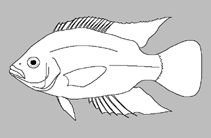
Dorsale stekels (totaal) : 12 - 14; Dorsale zachte stralen (totaal) : 9 - 11; Anale stekels: 3; Anale zachte stralen: 8 - 9. This species is distinguished from its congeners of the rhabdotus group and fromG. balzanii by the shape of the caudal peduncle which is longer than deep (vs. deeper than long); differs from all congeners, except labiatus and pseudolabiatus, by having thick lips; differs from labiatus and lacustris by the absence of an oblique bar from the eye to the dorsal-fin origin (vs. present), and by the color pattern of the caudal, dorsal and anal fins with dots (vs. caudal fin and posterior portion of anal fin with longitudinal hyaline stripes); differs from pseudolabiatus and mekinos by the hump entirely black in males (vs. yellow with black margin), and the upper lip not folded dorsally over anterior margin of snout (vs. folded dorsally, usually with a well-developed medial lobe dorsally projected in pseudolabiatus) (Ref. 123558).
Cross section: compressed.
Collected in rivers with clear water, usually with rocky or muddy bottom and little vegetation (Ref. 123558).
Levenscyclus en paargedrag
Maturiteit | Voortplanting | Paaien | Eieren | Fecunditeit | Larven
Turcati, A., W.S. Serra-Alanis and L.R. Malabarba, 2018. A new mouth brooder species of Gymnogeophagus with hypertrophied lips (Cichliformes: Cichlidae). Neotropical Ichthyol. 16(4): e180118: 1-9. [First published online with fixed layout, pp. 1-9, 14 Dec. 2018.] (Ref. 123558)
Status op de Rode Lijst van het IUCN (Ref. 130435: Version 2025-2 (Global))
Gevaar voor de mens
Harmless
Gebruik door de mens
Tools
Speciale rapporten
Download XML
Internetbronnen
Schattingen op basis van modellen
Fylogenetische diversiteitsindex (Ref.
82804): PD
50 = 0.5000 [Uniqueness, from 0.5 = low to 2.0 = high].
Bayesian length-weight: a=0.01995 (0.00918 - 0.04336), b=3.01 (2.83 - 3.19), in cm total length, based on LWR estimates for this (Sub)family-body shape (Ref.
93245).
Trofisch niveau (Ref.
69278): 3.3 ±0.5 se; based on size and trophs of closest relatives
Weerstandsvermogen (Ref.
120179): Hoog, minimale populatieverdubbelingstijd minder dan 15 maanden (Preliminary K or Fecundity.).
Kwetsbaarheid van de visserij (Ref.
59153): Low vulnerability (10 of 100).
🛈