Classification / Noms
Noms communs | Synonymes | Catalog of Fishes(Genre, Espèce) | ITIS | CoL | WoRMS | Cloffa
>
Anabantiformes (Gouramies, snakeheads) >
Aenigmachannidae (Gollum snakehead fishes)
Etymology: Aenigmachanna: Name from Latin word 'aenigma', for enigma, and Channa, the genus name of Asian snakeheads; gollum: Named after the character from J. R. R. Tolkien’s books ‘The Hobbit’ and ‘The Lord of the Rings’. Gollum is a creature that went underground and during its subterranean life changed its morphological features; noun in apposition.
Eponymy: The genus and these species are named after the fictional character, Gollum, in J R R Tolkien’s The Hobbit and Lord of the Rings. [...] (Ref. 128868), visit book page.
Environnement : milieu / zone climatique / profondeur / gamme de distribution
Écologie
; eau douce benthopélagique. Tropical
Asia: India.
Taille / Poids / Âge
Maturité: Lm ? range ? - ? cm
Max length : 12.7 cm SL mâle / non sexé; (Ref. 120659)
Description synthétique
Clés d'identification | Morphologie | Morphométrie
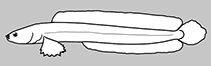
This species is distinguished from species of Channa and Parachanna by the following unique characters among channids: very slender with maximum body depth only 11.1-11.3% SL; eel-like body with head length only 20.8-21.6% SL; a large mouth with jaw length 60.4-61.1 % HL; A 43-44; absence of a body lateral line with pored scales; scales in a lateral series 83-85; colour pattern and absence of buoyancy; differs from other channids by having 64 vertebrae, D 56-57, and absence of pelvic fins (Ref. 120401).
Cross section: circular.
The fish collected from Malappuram was in a paddy field (Ref. 120401). The fish collected from Peringara was found, at the height of summer, with the water surface in the well was at a depth of about 5 metres below the ground surface; it came to light when the water in the well, normally clear, suddenly turned muddy and the well was drained to facilitate cleaning. Peringara is situated in a large natural wetland that abuts the Kuttanad lowlands, kniwn as ‘the rice bowl’ of Kerala (Ref. 120659).
Cycle de vie et comportement reproducteur
Maturité | Reproduction | Frai | Œufs | Fécondité | Larves
Britz, R., V.K. Anoop, N. Dahanukar and R. Raghavan, 2019. The subterranean Aenigmachanna gollum, a new genus and species of snakehead (Teleostei: Channidae) from Kerala, South India. Zootaxa 4603(2):377-388. (Ref. 120401)
Statut dans la liste rouge de l'IUCN (Ref. 130435: Version 2025-2 (Global))
Vulnérable (VU) (B1ab(ii,iii)+2ab(ii,iii)); Date assessed: 28 February 2020
Menace pour l'homme
Harmless
Utilisations par l'homme
Outils
Articles particuliers
Télécharger en XML
Sources Internet
Estimations basées sur des modèles
Indice de diversité phylogénétique (Réf.
82804): PD
50 = 1.5000 [Uniqueness, from 0.5 = low to 2.0 = high].
Bayesian length-weight: a=0.00389 (0.00180 - 0.00842), b=3.12 (2.94 - 3.30), in cm total length, based on all LWR estimates for this body shape (Ref.
93245).
Niveau trophique (Réf.
69278): 3.4 ±0.5 se; based on size and trophs of closest relatives
Vulnérabilité de la pêche (Ref.
59153): Low vulnerability (10 of 100).
🛈