Classificação / Nomes
Nomes comuns | Sinônimos | Catalog of Fishes(Gênero, Espécies) | ITIS | CoL | WoRMS | Cloffa
>
Cyprinodontiformes (Rivulines, killifishes and live bearers) >
Fluviphylacidae (American lampeyes)
Etymology: Fluviphylax: Latin, fluvius = river + Greek,phylax, -akos = guardian (Ref. 45335); wallacei: Named for the British naturalist Alfred Russel Wallace (1823-1913).
Eponymy: Alfred Russel Wallace (1823–1913) was an English naturalist, evolutionary scientist, geographer and anthropologist and one of the greatest men of science of his age. [...] (Ref. 128868), visit book page.
Meio ambiente: milieu / Zona climática / intervalo de profundidade / faixa de distribuição
Ecologia
; Água doce bentopelágico; intervalo de profundidade 0 - 1 m (Ref. 123788). Tropical
South America: Brazil.
Tamanho / Peso / Idade
Maturidade: Lm ? range ? - ? cm
Max length : 1.5 cm SL macho/indeterminado; (Ref. 123788); 1.3 cm SL (female)
Descrição suscinta
Chaves de identificação | Morfologia | Morfometria
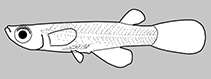
Raios dorsais (total) : 5 - 7; Raios anais : 7 - 9; Vértebras: 27 - 28. This species is distinguished from its congeners by having a sexual dimorphic pattern on cephalic lateral line system, males have whole opened sensory canals while females have the anterior section of supra-orbital, posterior infra-orbital and preopercular canal dorsal portion closed; males with pointed dorsal fin (vs. rounded). It is similar to F. gouldingi and differs from all other congeners by having a slender retroarticular (vs. deep) and with triangular opercle (vs. scale-like); the head free neuromasts not placed in shallow grooves (vs. in shallow grooves) and with orange colouration on the posterior region of the pectoral fin in males (vs. absent); also it has 2-4 black bars on the anterior portion of the flank in preserved male (vs. absent); males with anal fin elongate and pointed, reaching vertical to dorsal-fin tip (vs. short and rounded); male pelvic-fin reaching base of the fifth anal-fin ray (vs. reaching base of third anal-fin ray); ventral process of posttemporal short (vs. long); mesethmoid rounded; presence of sexual dimorphism in urogenital papillae morphology (vs. absent) (Ref. 123788).
Cross section: compressed.
In the Igarapé Mauaú, this species was collected in a shallow area, about 30-70 cm deep, in a slow flowing high transparency black-water stream, with sandy beaches and leaf litter areas on the bottom near stream margin. It was found forming shoals of about 15-20 individuals that were swimming near the surface. This species was found sympatrically with the Hyporhamphus brederi (Ref. 123788).
Ciclo de vida ou comportamento de acasalamento
Maturidade | Reprodução | Desova | Ovos | Fecundidade | Larvas
Bragança, P.H.N., 2018. Fluviphylax gouldingi and F. wallacei, two new miniature killifishes from the middle and upper Rio Negro drainage, Brazilian Amazon (Teleostei, Cyprinodontiformes, Cyprinodontoidei). Spixiana (München) 41(1):133-146. [German translation appeared in DKG-Journal, 52(1):Feb. 2020:1-18.] (Ref. 123788)
Status na Lista Vermelha da UICN (Ref. 130435: Version 2025-2 (Global))
Ameaça para os humanos
Harmless
Uso pelos humanos
Pescarias: sem interesse
Ferramentas
Relatórios especiais
Baixar XML
Fontes da internet
Estimativas baseadas em modelos
Índice de diversidade filogenética (Ref.
82804): PD
50 = 0.5078 [Uniqueness, from 0.5 = low to 2.0 = high].
Bayesian length-weight: a=0.00537 (0.00207 - 0.01392), b=3.09 (2.87 - 3.31), in cm total length, based on LWR estimates for this (Sub)family-body shape (Ref.
93245).
Nível Trófico (Ref.
69278): 3.0 ±0.4 se; based on size and trophs of closest relatives
Vulnerabilidade da pesca (Ref.
59153): Low vulnerability (10 of 100).
🛈